AI Risk Readiness · Inventory

What an AI Inventory Should Contain

Ask for an AI inventory and you usually get a list of AI projects: the chatbot, the fraud model, the document reader. That list answers "what did we build". It does not answer the question that matters on a bad day: which business process stops, or goes wrong, when this model, this key or this vendor fails or changes? Answering that takes several kinds of row, linked, in the records you already keep.

Last reviewed against the regulators’ texts on 17 November 2026. Rules change; check the Sources at the end before you act on this chapter.
Infozense · 17 November 2026 · CIO · CDO · CISO · ~8 minutes

Chapter 1 showed that the AI an organisation uses belongs in records it already keeps: the IT asset register, the register of outside providers, the BIA and the BCP. Chapter 2 turned that into committee questions, each answered with a number from one of those records. This chapter describes what the inventory behind those numbers should contain, and where the AI it usually misses comes from.

Why this matters. When a model provider retires a model version, it publishes a date. In our view, an organisation that can list every process that calls that model, through which key, owned by whom, copes better than one that has to find out. The same list serves on harder days: an outage, an unannounced model change, a question from the data protection officer.

A list of AI projects cannot produce that list. A project is one row. The dependency behind it is six or seven.

The word "inventory" suggests a spreadsheet with one row per AI system. That is a reasonable start, and where most organisations stop.

The trouble shows up the first time something fails. The chatbot row does not say which model version it calls, which API key it uses, who can revoke that key, or whether the same model also sits behind the claims assistant two floors down. The answers exist, scattered across procurement files, cloud consoles, code and people's heads. The inventory links them.

Who this is for

The CIO, CDO or CISO of any regulated organisation who will be asked to produce the inventory, and the data protection officer, risk and audit people who will rely on it. Banking is the worked example, as in chapters 1 and 2.

Nothing here needs a particular product. A well-kept spreadsheet that follows these rules beats a tool that does not.

Start from the business process, not from the technology

The first row is not a model. It is a business activity that AI supports: assessing a loan application, answering a customer, drafting a credit memo, reading an invoice.

Starting there ties the inventory to the records the risk function already owns: the process list and the BIA. Every later question, about criticality, fallback or who must be told, is a question about a process, which an inventory that starts from servers cannot answer.

Fourteen kinds of row

In our method, an AI inventory holds fourteen kinds of record. That is our working model, not a standard. Most organisations already track a few of them somewhere. Few link them.

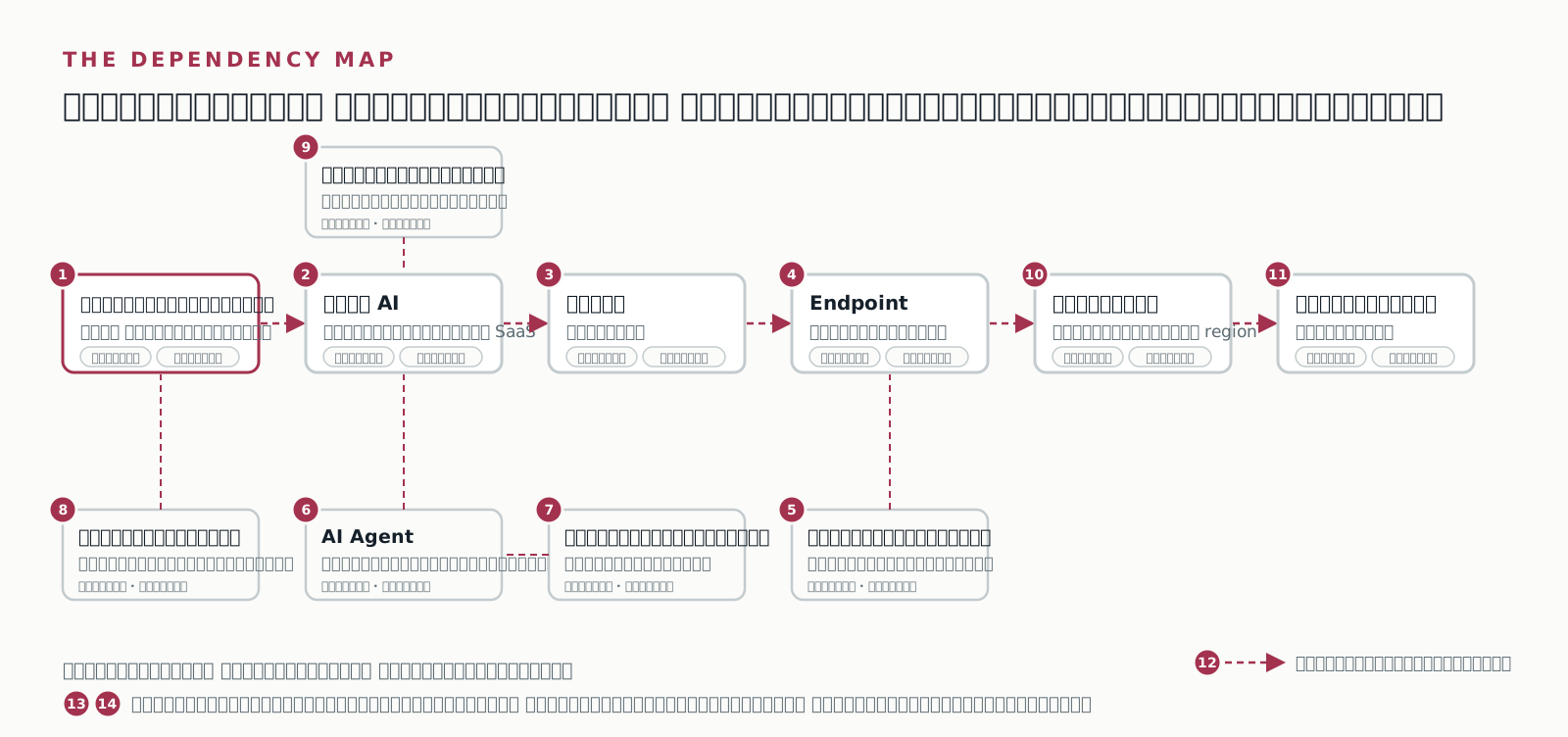
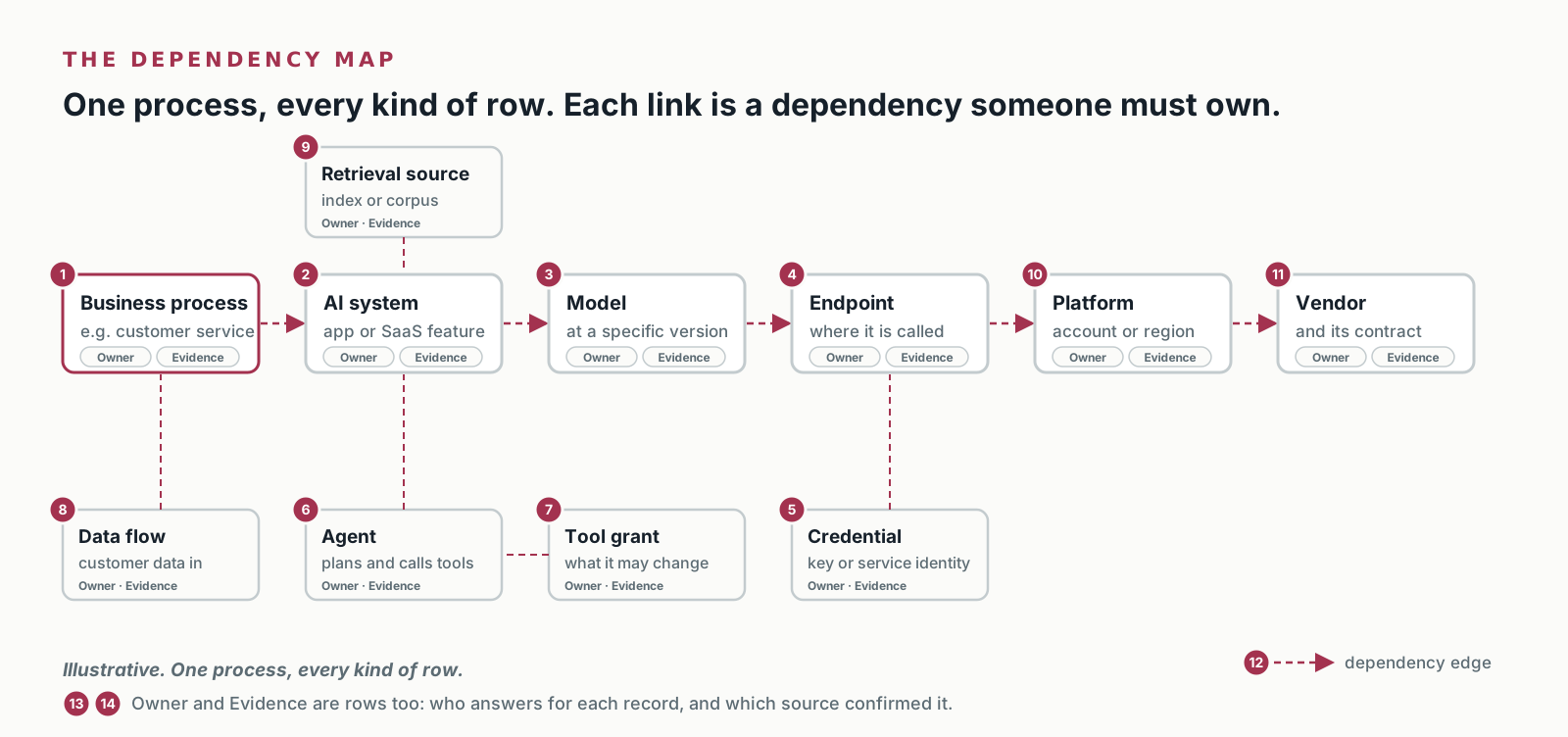
An illustrative dependency map for one business process, showing every kind of inventory row. A chain runs left to right: business process, AI system or application, model at a specific version, endpoint, platform or region, and vendor and contract. Hanging off the chain: a data flow from the process into the AI system, an agent with a tool grant, a credential used at the endpoint, and a retrieval source feeding the AI system. Every node carries an owner tag and an evidence tag. Dashed lines are dependency edges. แผนภาพการพึ่งพาของกระบวนการหนึ่งเพื่อเป็นตัวอย่าง แสดงรายการในทะเบียนครบทุกประเภท โซ่จากซ้ายไปขวา ได้แก่ กระบวนการทางธุรกิจ ระบบหรือแอปพลิเคชัน AI โมเดลที่ระบุเวอร์ชัน endpoint แพลตฟอร์มหรือ region และผู้ให้บริการพร้อมสัญญา ห้อยออกจากโซ่ ได้แก่ การไหลของข้อมูลจากกระบวนการเข้าสู่ระบบ AI, AI agent พร้อมสิทธิ์ในการใช้เครื่องมือ, credential ที่ใช้เรียก endpoint และแหล่งข้อมูลสำหรับการค้นคืน ทุกกล่องมีป้ายเจ้าของและหลักฐาน เส้นประคือความสัมพันธ์แบบพึ่งพา
Illustrative. One process, every kind of row.

1. Use case or business process. The business activity the AI supports, tied to your process list or BIA. It carries how critical the process is, and what happens if the AI is wrong or unavailable.

2. AI system or application. The deployed thing that contains or calls AI: your own application, a SaaS product, or a feature inside a platform.

3. Model. A specific model, at a specific version, in a specific deployment. The version matters: providers retire models and can update the model behind an alias without notice; a pinned version does not change. If you keep a model inventory for credit or risk models, this row belongs there; check that it reaches generative and vendor models.

4. Endpoint. The network address through which the model or AI service is called: what a firewall rule allows and a log records.

5. Credential. The API key, service account or token used to reach the AI service. The inventory records its name, store, owner and scope. The key itself stays in the secrets store; the service account belongs in the access review.

6. Agent. Software that plans and then acts by calling tools. Its risk is set by what it is allowed to do, not by which model it uses.

7. Agent tool grant. One tool an agent may call, with what it is allowed to do. Read-only document search and the power to create payment orders are separate rows, because their risk is very different.

8. Data flow. A category of data moving between two records, such as customer data from the CRM to a model endpoint. It links the inventory to the record of processing activities, and to the data processing agreement that says where the data is processed and whether the provider may train on it.

9. Retrieval source. An index or document collection the AI reads to ground its answers. When it goes stale, answers get worse without any error.

10. Platform or hosting location. The cloud account, tenancy, region or on-premise cluster where something runs, and where data location and all-region outage questions are answered.

11. Vendor and contract. The supplier as a legal entity, with the contract that governs it: data use, data location, change notice, exit. One vendor often sits behind several systems, some only through another vendor.

12. Dependency link. A directed link between any two records: this process uses this system, this system calls this model, this model runs in this region. Without links, the other thirteen are just lists.

13. Owner. A named role holder for each record. An unowned row is a row nobody will update, review or switch off.

14. Evidence. One observation, from one source, that supports a record. It shows an auditor, and you, why the row can be trusted.

For what an AI platform should record about its own decisions, see You Say Your AI Is Governed. Six Months Later, Can You Show It?.

Built into the records you already keep

None of this needs a new register. Most rows have a home in a record you already keep.

Record you already keepRows it can hold
Process list and BIAUse case or business process, with its criticality
IT asset register, and the model inventory where one existsAI system, model, agent, endpoint, retrieval source, platform
Third-party or outsourcing register, with the contract recordsVendor and contract
Record of processing activities, with the data processing agreementsData flows that carry personal data
Secrets store and access reviewCredential metadata, and the accounts behind agent tool grants

What is usually new is the links, an owner on every row, and the evidence. BOT’s IT risk notification requires banks to keep a register that identifies IT assets completely (attachment 2, clause 1). The NCSA code of practice requires the asset inventory of a critical service to record dependencies between assets (21.1.1 (ฉ)); those are the links. The SEC’s AI governance framework recommends an AI inventory for the capital market. Chapter 1 covers insurers and other sectors.

Why each row earns its place

Each row is there because a question cannot be answered without it. Most of the questions are chapter 2’s.

  • "Which processes stop if this provider is down?" needs process, system, model, platform, vendor and the links between them (question 9).
  • "Can we cut off this AI right now, and what can it do before we do?" needs the credential, its owner, the agent and its tool grants (question 7).
  • "Where does personal data reach a model, and on what terms?" needs data flows, endpoints, hosting locations and the vendor contract (question 5).
  • "Are we exposed to one vendor?" needs vendor and contract rows linked to every system they sit behind, including through another vendor (question 6).
  • "What changed when the provider updated the model?" needs the model at its version, the systems that call it, and evidence of the last test (question 8).
  • "Why should I believe this register?" needs owners and evidence (question 1).

Five rules that keep it honest

  • Unknown is a value. If a fact cannot be found, write "unknown". A blank looks like an oversight; "unknown" is a finding you can count.
  • One source is not enough. Interviews find intended use, purchase records find paid vendors, logs find actual calls. A row confirmed by one source deserves a second look.
  • Facts first, judgements later. The inventory records what exists. Materiality and control adequacy are judged afterwards, by the people accountable for them.
  • No secrets, no names. Credential rows hold metadata only; the key stays in the secrets store. Staff use of public AI is recorded by tool and department, not by named employee.
  • It stays inside. An inventory that lists where keys live and which agents can write is sensitive. Classify it as confidential or higher under your own scheme, and keep it inside your environment.

Where the missing rows come from

An inventory built from approved projects is accurate about those projects. The AI it misses comes in through three other doors, none of which passes a procurement or change gate.

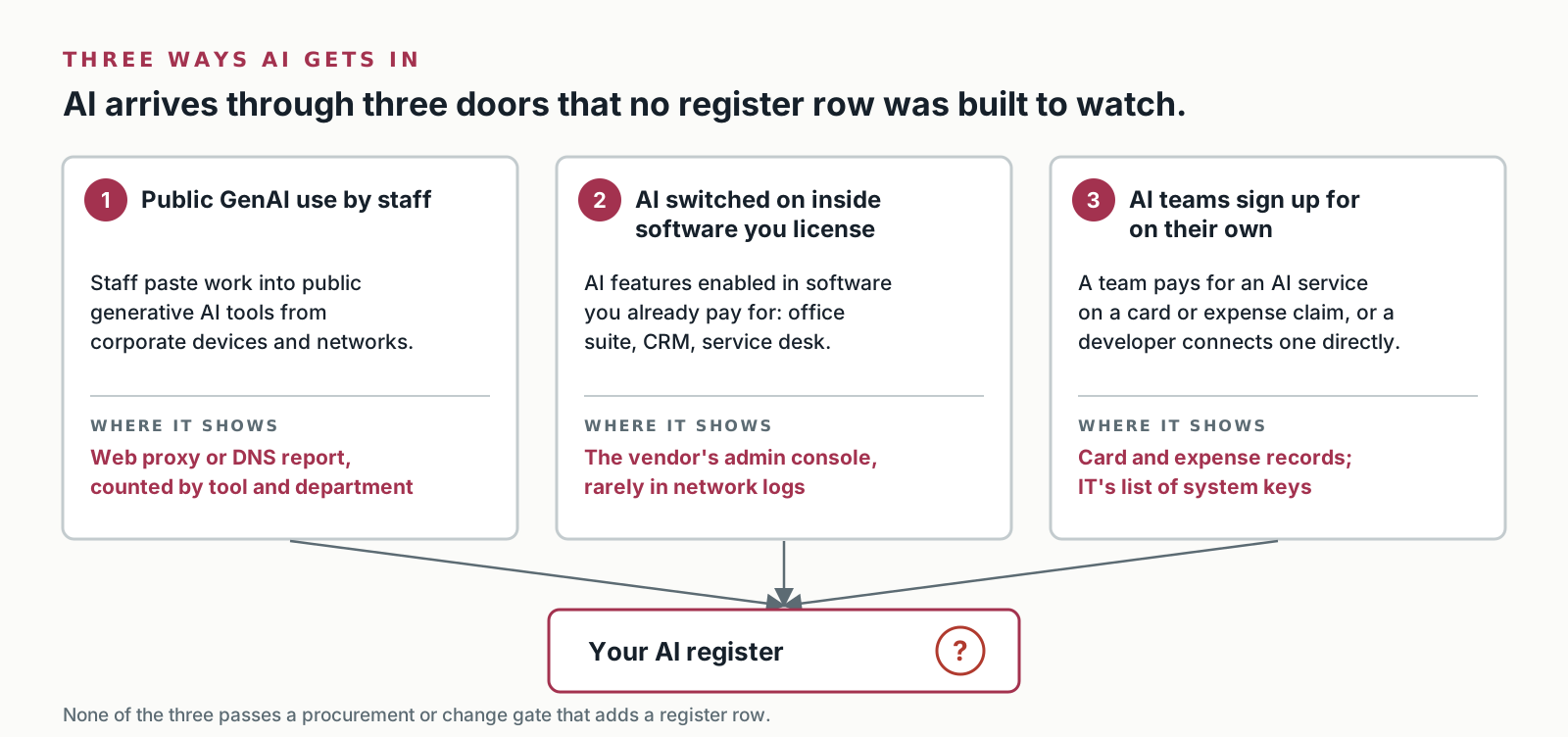
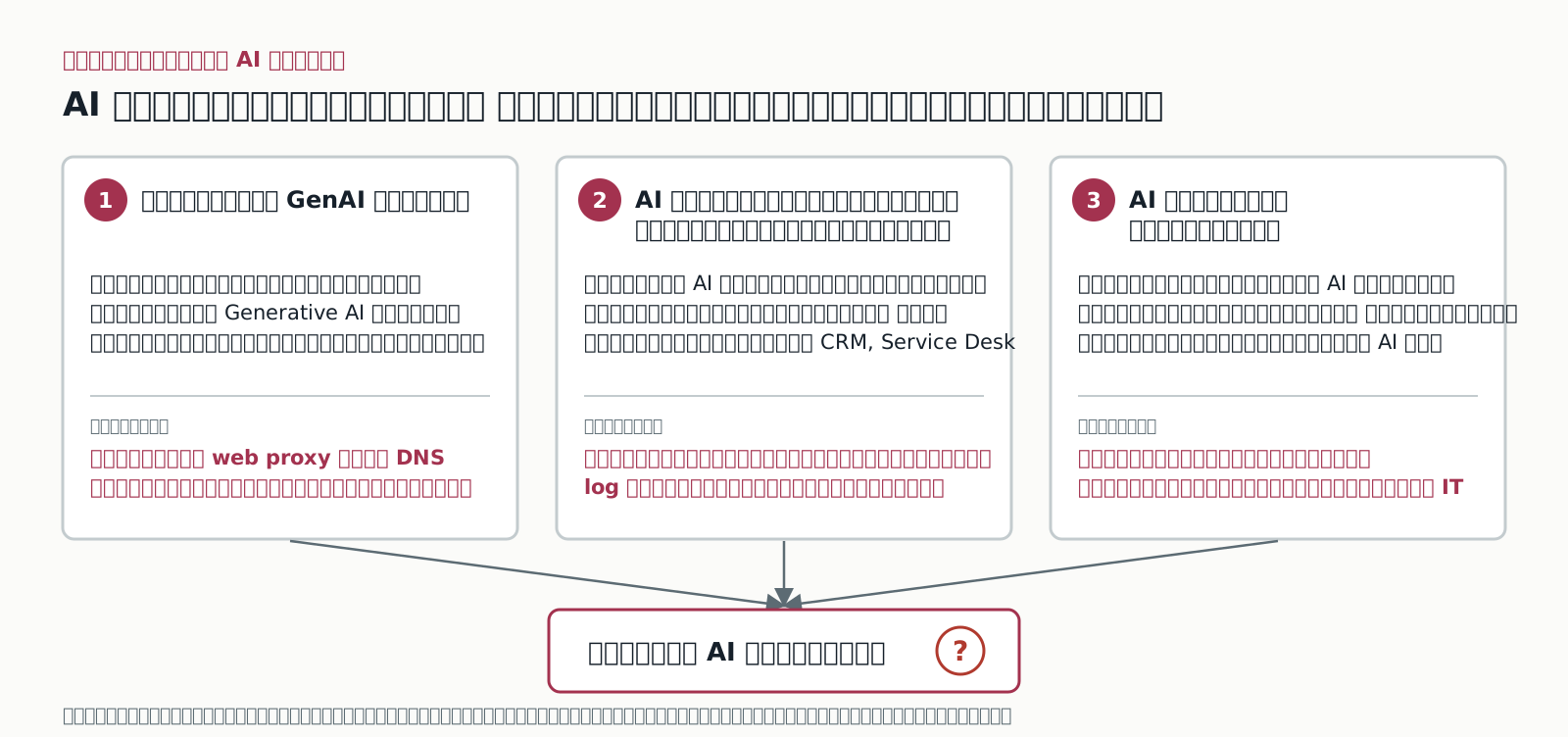
Three ways AI gets into an organisation without a register row. One: staff use public generative AI tools; a web proxy or DNS report shows it, counted by tool and department. Two: AI features are switched on inside software the organisation already licenses; this shows in the vendor's admin console, and is rarely distinguishable in network logs. Three: teams sign up for AI on their own, paying on a card or an expense claim, or a developer connecting a system to an AI service directly; these show in card and expense records and in IT's list of system keys. All three arrows point to a register marked with a question mark. สามช่องทางที่ AI เข้าสู่องค์กรโดยไม่มีรายการในทะเบียน ช่องทางแรก พนักงานใช้เครื่องมือ Generative AI สาธารณะ ซึ่งดูได้จากรายงาน web proxy หรือ DNS นับแยกตามเครื่องมือและหน่วยงาน ช่องทางที่สอง ฟังก์ชัน AI ที่เปิดใช้อยู่ในซอฟต์แวร์ที่องค์กรมีสิทธิ์ใช้งานอยู่แล้ว ซึ่งดูได้จากหน้าจอผู้ดูแลระบบของผู้ให้บริการ และ log ของเครือข่ายมักแยกไม่ออก ช่องทางที่สาม ทีมงานสมัครใช้ AI เอง โดยจ่ายด้วยบัตรหรือเบิกเป็นค่าใช้จ่าย หรือนักพัฒนาเชื่อมระบบเข้ากับบริการ AI เอง ซึ่งดูได้จากรายการบัตรและค่าใช้จ่าย และจากรายชื่อคีย์เชื่อมระบบของฝ่าย IT ลูกศรทั้งสามชี้ไปที่ทะเบียนที่มีเครื่องหมายคำถาม
Three doors AI comes in through. None of them passes a gate that adds a register row.
  • Public generative AI used by staff. Shows up in web proxy or DNS reports, counted by service and by department.
  • AI features switched on inside software you already license. Shows up in each vendor's admin console: feature settings and AI add-on licences.
  • AI teams sign up for on their own. A team pays for an AI service on a card or expense claim, or a developer connects a system to one directly. Shows up as payments to AI providers in expense and corporate card records, and as key names in the secrets store.

These are three spot checks your own staff can run. If your register is complete, all three come back empty, which is worth knowing too.

What your network logs usually miss

Network logs serve the first door well. They serve the second poorly: an AI feature inside licensed software talks to a vendor domain you already allow, so in proxy and DNS logs it is usually indistinguishable from ordinary use. Its evidence sits in the admin console, the contract and the invoice; a later chapter, on AI inside licensed software, covers this in detail.

The honest limit

An inventory is a record, not a control. A complete, current inventory tells you what you depend on and makes none of it more resilient. Every later control reads from it; on its own it fixes nothing.

Completeness is never proven, only approached. The honest claim is "confirmed by these sources, on this date", and the evidence rows make that claim checkable.

The bottom line

An inventory of AI projects answers a question nobody asks under pressure. One that links process, system, model, credential, vendor and owner answers the questions everyone asks: what stops, what changed, and who can act.

Build it into the registers you already keep, as chapter 1 suggested, and the numbers from chapter 2 become a filter on a table rather than a project. The remaining chapters put the inventory to work: on the AI that arrives inside licensed software, and on the continuity plan for the day an AI service fails.

Sources

The texts this chapter cites, as each regulator published them on the date of this article. Where this article’s wording differs from the original texts, the originals govern.

  • Bank of Thailand. ประกาศ ที่ สกช. 5/2566 เรื่อง หลักเกณฑ์การกำกับดูแลความเสี่ยงด้านเทคโนโลยีสารสนเทศ (Information Technology Risk) ของสถาบันการเงินและสถาบันการเงินเฉพาะกิจ, with its attachments and the two attached guidelines (IT risk management; third-party risk management), circular ฝตท.(01) ว. 20/2566, 9 November 2023. PDF, Thai
  • National Cyber Security Committee. ประกาศคณะกรรมการกำกับดูแลด้านความมั่นคงปลอดภัยไซเบอร์ เรื่อง ประมวลแนวทางปฏิบัติและกรอบมาตรฐานด้านการรักษาความมั่นคงปลอดภัยไซเบอร์ สำหรับหน่วยงานของรัฐและหน่วยงานโครงสร้างพื้นฐานสำคัญทางสารสนเทศ พ.ศ. 2564, Royal Gazette, 6 September 2021. PDF, Thai
  • Securities and Exchange Commission, Thailand. กรอบการกำกับดูแลการใช้งานปัญญาประดิษฐ์ในภาคตลาดทุน ฉบับปรับปรุงครั้งที่ 1 (AI Governance Framework and Handbook, 1st Revised Edition), August 2026. PDF, Thai

This article is general information about regulatory texts as published on the review date above. It is not legal, regulatory or compliance advice, and reading it does not create a client relationship. Each organisation must read the original texts and decide how they apply, with its own compliance function and advisers. INFOZENSE accepts no liability for decisions made on the basis of this article.

AI Risk Readiness

Could you list every process behind one AI provider from your records?

If not, the inventory is where to start. We can go through your existing records with you and show which rows are missing, without your data leaving your environment.

Let's talk →

Read about AI Risk Readiness →

contact@infozense.com  |  +66-82-242-4008  |  Bangkok, Thailand