You Say Your AI Is Governed. Six Months Later, Can You Show It?
Every AI governance claim is easy to make on the day you make it. The hard version arrives months later, from someone who was not in the room, asking what your AI did in March and expecting evidence rather than assurance. Why? Because a log your administrator can quietly edit is not evidence, it is a story. A governed data layer is the software between your AI and your documents, and it keeps a record that survives the person who runs it. That record includes the refusals. When someone asks for something they should not get, the refusal is the only trace that they asked.
Infozense Knowledge Engineering · If you hold staff or customer data · ~6 minutes
This is the Operational piece of the Infozense Knowledge Engineering library. The data layer beneath your agent has five gates: Input (who may ask) · Egress (what may leave) · Output (safe and true) · Action (who approves) · Operational (prove it later). This piece is about the fifth: Operational, the gate that decides whether you can still demonstrate any of the other four after the fact.
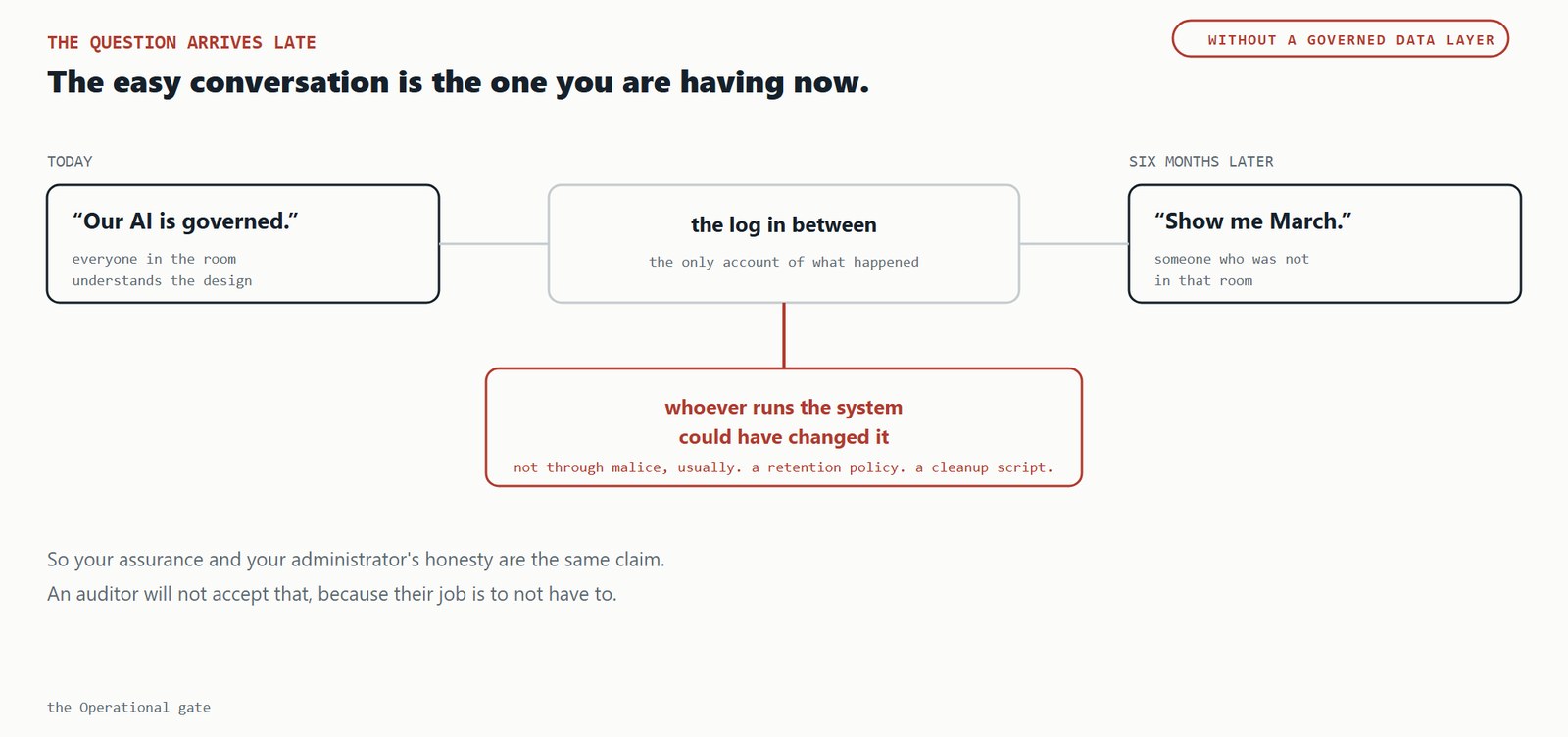
Your assurance and your administrator's honesty are the same claim. An auditor will not accept that, because their job is to not have to.
The governance conversation you are having now is the easy one.
The hard version of the conversation happens later, and it goes differently. Someone who was not in that room asks what your AI did in March. They do not want your policy. They want to be shown.
Who this is for
If nobody will ever ask you to demonstrate what your AI did, this is not your problem. Plenty of organizations are genuinely in that position and should not spend money here.
You have this problem if you are regulated, if you handle other people's personal data, if you are going to be acquired, or if you have a large customer whose own auditors will eventually work their way down to you. The common feature is that at some point a person with standing will ask a question about the past, and your answer will need to be evidence rather than recollection.
Note who that person is not. They are not attacking you. They are usually just doing their job, and they will accept a good answer immediately. The failure mode here is rarely being caught doing something wrong. It is being unable to show that you did the right thing.
A log is not a record
Most systems have logs. Very few have records, and the distinction is the whole subject.
A log is operational exhaust. It exists so that engineers can debug, it is often the first thing trimmed when storage gets expensive, and critically, the people who run the system can change it. Not through malice, usually. Through a retention policy, a reindex, a cleanup script, a migration that dropped a field nobody was using.
A record is something else. A record is what remains when the person who operates the system is not trusted to be part of the answer.
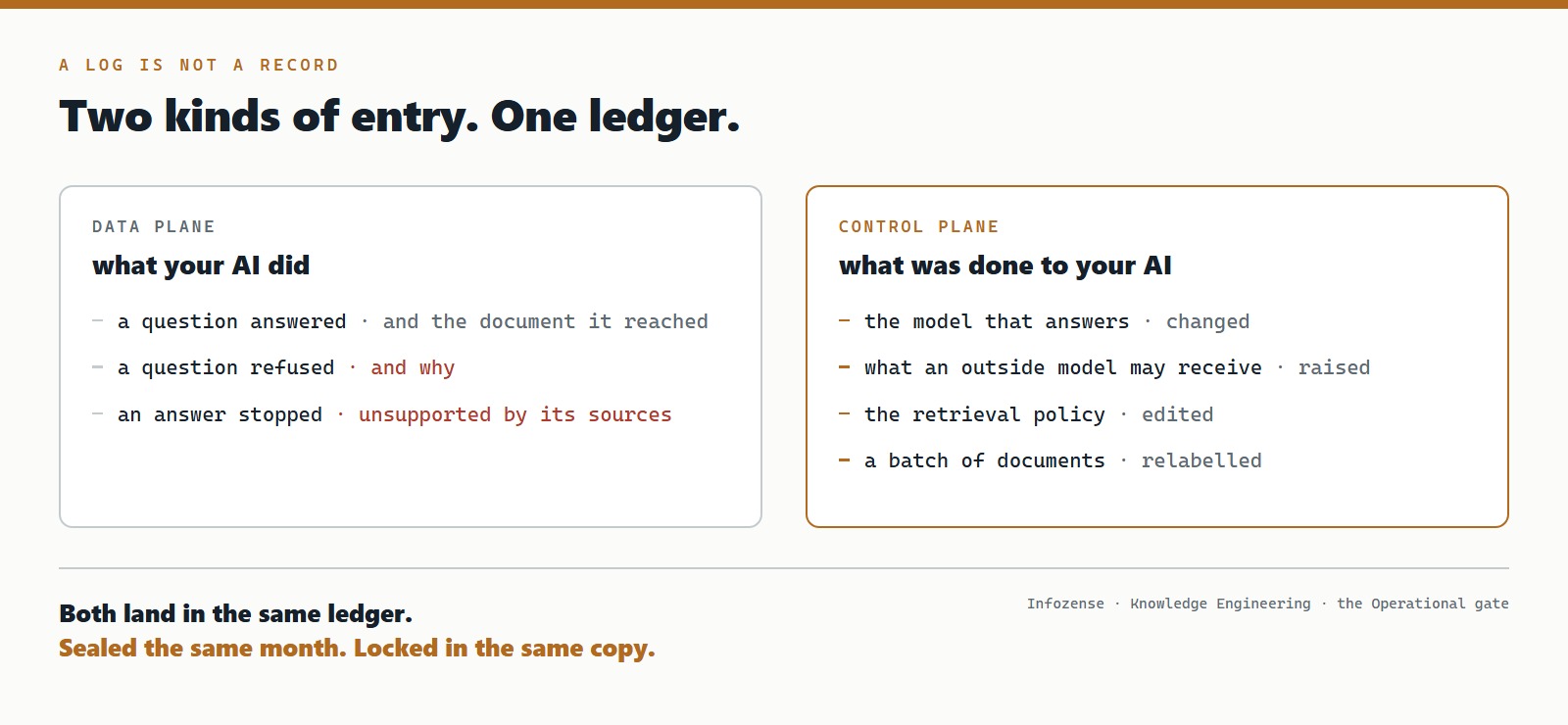
Two kinds of entry go into it, and they are not the same thing.
The data plane: what your AI did. Every question it answered, and every one it refused.
The control plane: what was done to your AI. Every change to the machinery: the model that answers, the sensitivity a model is allowed to receive, the policy that decides what gets retrieved.
One ledger, because both are things someone will later ask you to show.
That is the uncomfortable centre of this. An auditor is not really asking whether your AI did the right thing in March. They are asking whether you are in a position to be wrong about it. If the only account of March is one your administrator could have adjusted, then your assurance and your administrator's honesty are the same claim, and they will not accept that, because their job is to not have to.
Here is the test, and it takes one conversation. Ask whoever runs your AI system to delete a single entry from last March. Not as a trick, as an experiment. If they can do it, you have a log. If the system will not let them, you have a record.
Two layers, and the first one is not enough
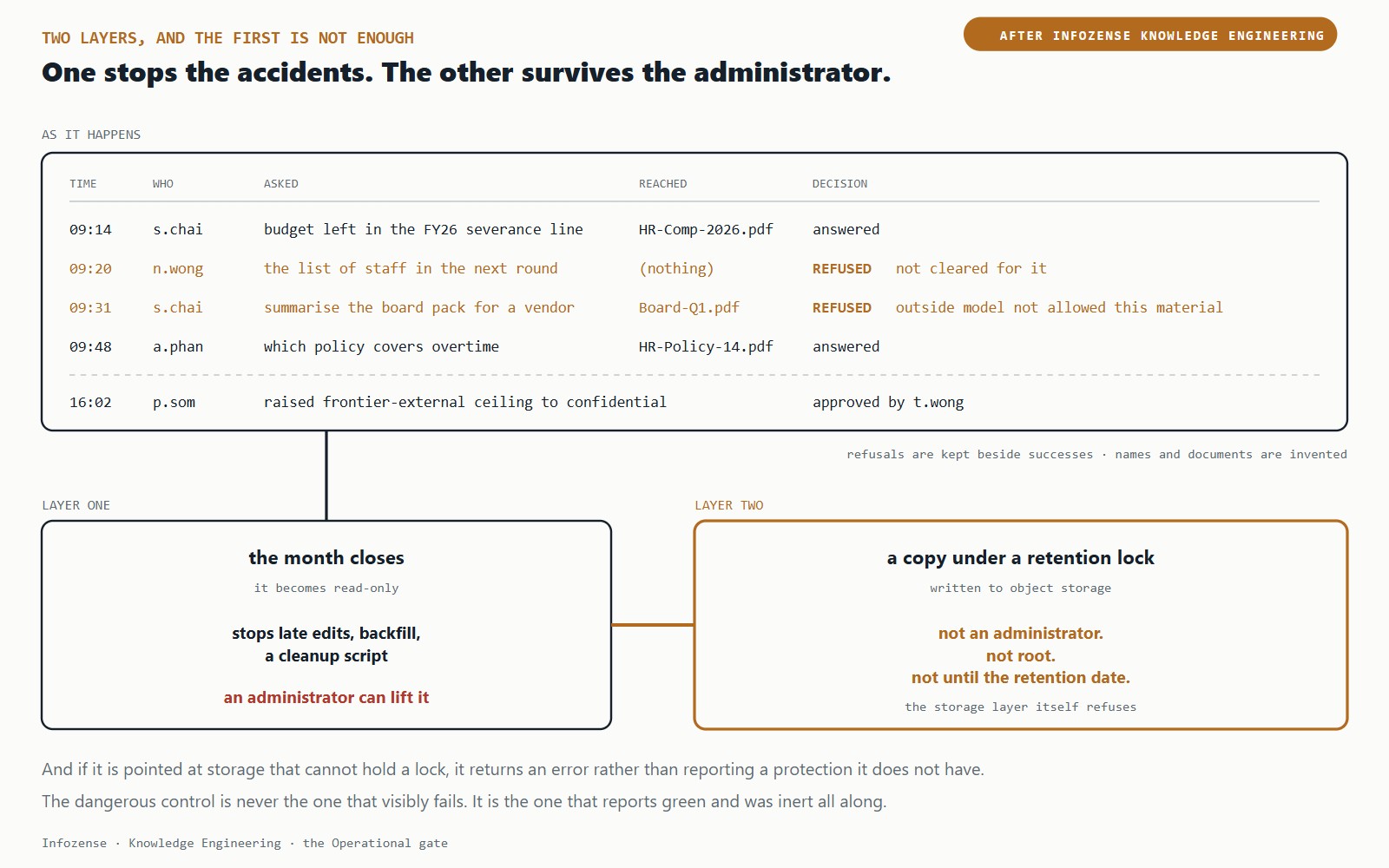
One layer stops the accidents. The other survives the administrator.
So a governed data layer keeps its history in two forms, and the difference between them is the point.
The first is a seal. Each month of history closes and becomes read-only once the next month begins. Nothing further can be written into a closed period, so the ordinary accidents stop: no late edits, no backfill, no script quietly rewriting last quarter.
That is genuinely useful and it is not sufficient, and it would be dishonest to present it as more than it is. A seal like this can be lifted by whoever administers the database the history is kept in. It protects against accident and drift, which is most of what actually goes wrong. It does not protect against the one person an auditor is professionally obliged to consider, which is the administrator.
So there is a second layer. A copy of each sealed period is written to object storage under a retention lock. Once written, that copy cannot be deleted or modified until its retention date passes. Not by an administrator. Not by root. The storage layer itself refuses, and your people have no authority there.
That is the version that answers the question. Not "our logs show", but "here is a copy neither I nor anyone at my company could have altered, and here is the date before which nobody can remove it".
There is a question worth putting to any vendor, including us. Ask when the record becomes impossible to change: at the moment of the event, at the end of the hour, or at the end of the month. The gap between that answer and the event is the window in which someone with access to the system could still edit it. Today, ours is the end of the month, and that is the part of this we are changing next.
The system refuses to pretend
One detail matters more than it sounds, and it is the thing I would look for in anyone's product, ours included.
A retention lock can only be enabled when the storage bucket is first created. You cannot switch it on afterwards. So a system that is told to protect a bucket which lacks that setting has two options: proceed quietly and let everyone believe the history is protected, or refuse and say so.
This one refuses. It returns an error rather than pretending a bucket is protected when it is not.
That distinction sounds small and is not. The dangerous failure in governance tooling is never the control that visibly does not work. It is the control that appears to work, is reported as green, and is discovered to have been inert on the day someone finally leans on it. A system that would rather fail loudly than report a protection it does not have is telling you something about how the rest of it was built.
Record what was refused
One more property, and it is the one people get wrong when they build this themselves.
The interesting entries are the refusals. A question refused because the person asking was not cleared for the document it needed. An answer stopped because the sources did not support it. An outside model that was not allowed to receive the material. These are not errors to be discarded. They are the evidence that the control was live and doing something.
A web server log can tell you that someone was refused at 09:20. It cannot tell you what they were reaching for. This record can, because the refusal happened at the end of a chain the layer had already followed: it read the question, found the documents that answer it, followed the references out of those documents to the ones they cite, and checked each one against what the person asking is allowed to see. The reason attached to the refusal is a by-product of the work that finds a good answer in the first place. A system that only stores and searches text has nothing to write down except a status code.
A history containing only successful operations proves that things happened. A history containing refusals proves that something was being enforced.
It is also what an attempt looks like. If anyone ever probes your AI, the record of that probe exists only if you decided in advance to keep the failures.
The bottom line
Governance you cannot demonstrate is governance you do not have. Not because it is fake, but because the only person it convinces is you, and you are not the one asking.
The question is not whether your rules were good. It is whether, months later, with the people who built it gone and the meeting forgotten, there is an account of what happened that does not depend on anyone's word. That account either exists or it does not, and the day you need it is the wrong day to find out.
You don't build this. You configure it.
You do not build a tamper-evident archive or write a retention pipeline. Infozense Knowledge Engineering ships the governed layer with the Operational gate already in place: every question your AI answers, and every one it refuses, is written as it happens, and so is every change to the models, the sensitivity rules and the retrieval policy, each month closes and becomes read-only, a copy of each closed period goes to locked object storage on a schedule you set, refusals are kept alongside successes, and the system tells you plainly if the storage it was pointed at cannot actually hold a lock.
You set the retention window and the destination. After that, the answer to "show me March" is a file, not a meeting.
The file is one compressed export per month, a few tens of megabytes for a busy deployment. It carries every answer and every refusal for that month, and the storage will not release it for deletion until the retention date you set.
audit-2026.03.ndjson.gz 18.4 MB shipped 2026-04-01 locked until 2033-04-01
One file: the closed month of March 2026, written to object storage on the first of April, under a lock that holds until 2033.
Infozense Knowledge Engineering
Will someone eventually ask you to demonstrate what your AI did?
That's the conversation we have best. Bring one real deployment, and we'll walk through what you could actually show them.