Consulting · AI · Excellence

AI Risk Readiness

We check whether the risk management you already run can see the AI you already use: the models, keys, agents, vendors and AI features behind your business processes. Then we help you write what is missing into the registers, business impact analysis (BIA) and business continuity plan (BCP) you already keep. No new framework. No new committee.

TraceableEVERY RATING SHOWS ITS SOURCE
Your recordsREGISTERS, IMPACT ANALYSIS (BIA) AND CONTINUITY PLAN (BCP) YOU ALREADY KEEP
No system accessTO START
IndependentNAMES OUTCOMES, NEVER PRODUCTS

The question it answers

Name the business processes that would stop if your main AI provider were unavailable tomorrow. Then show us the register rows that say so.
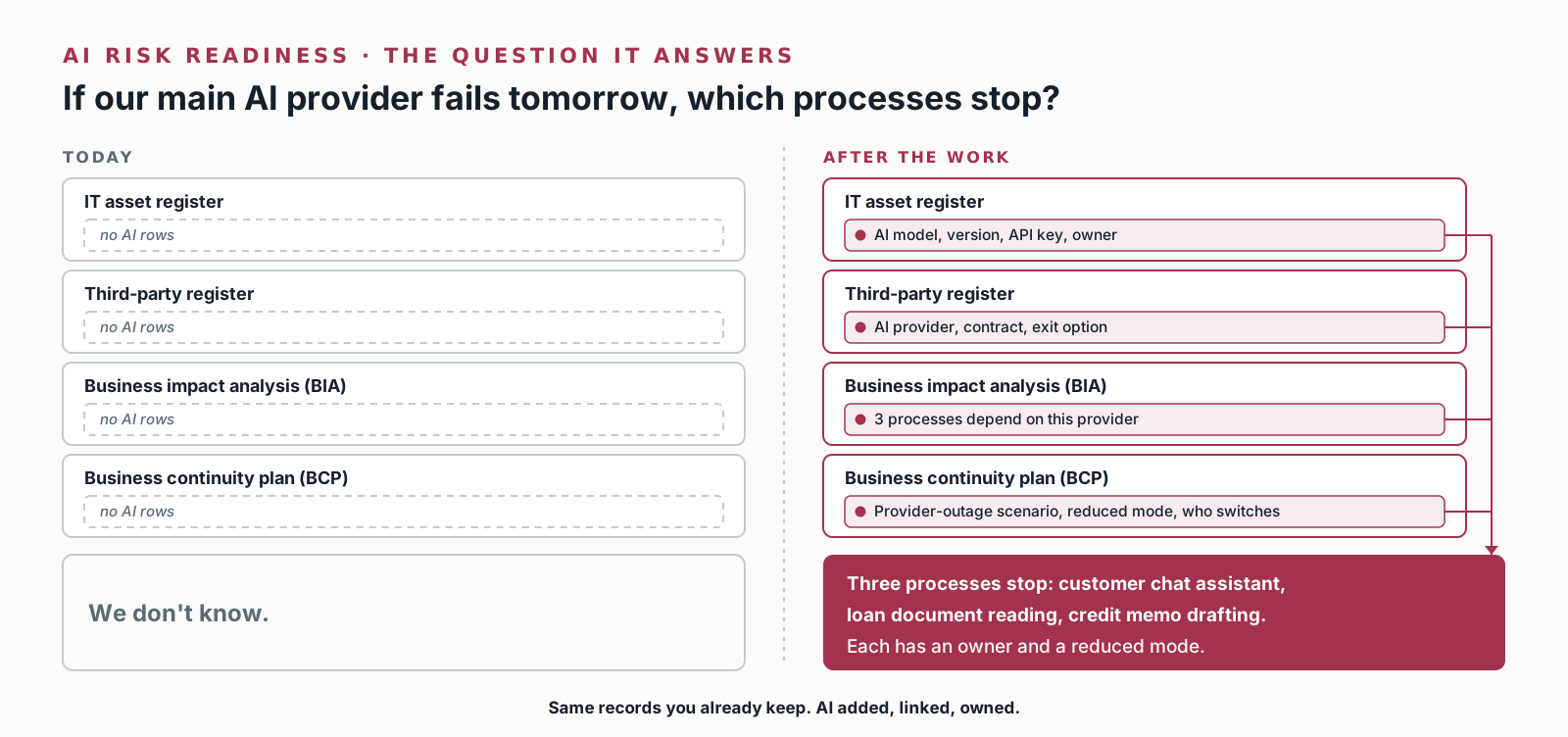
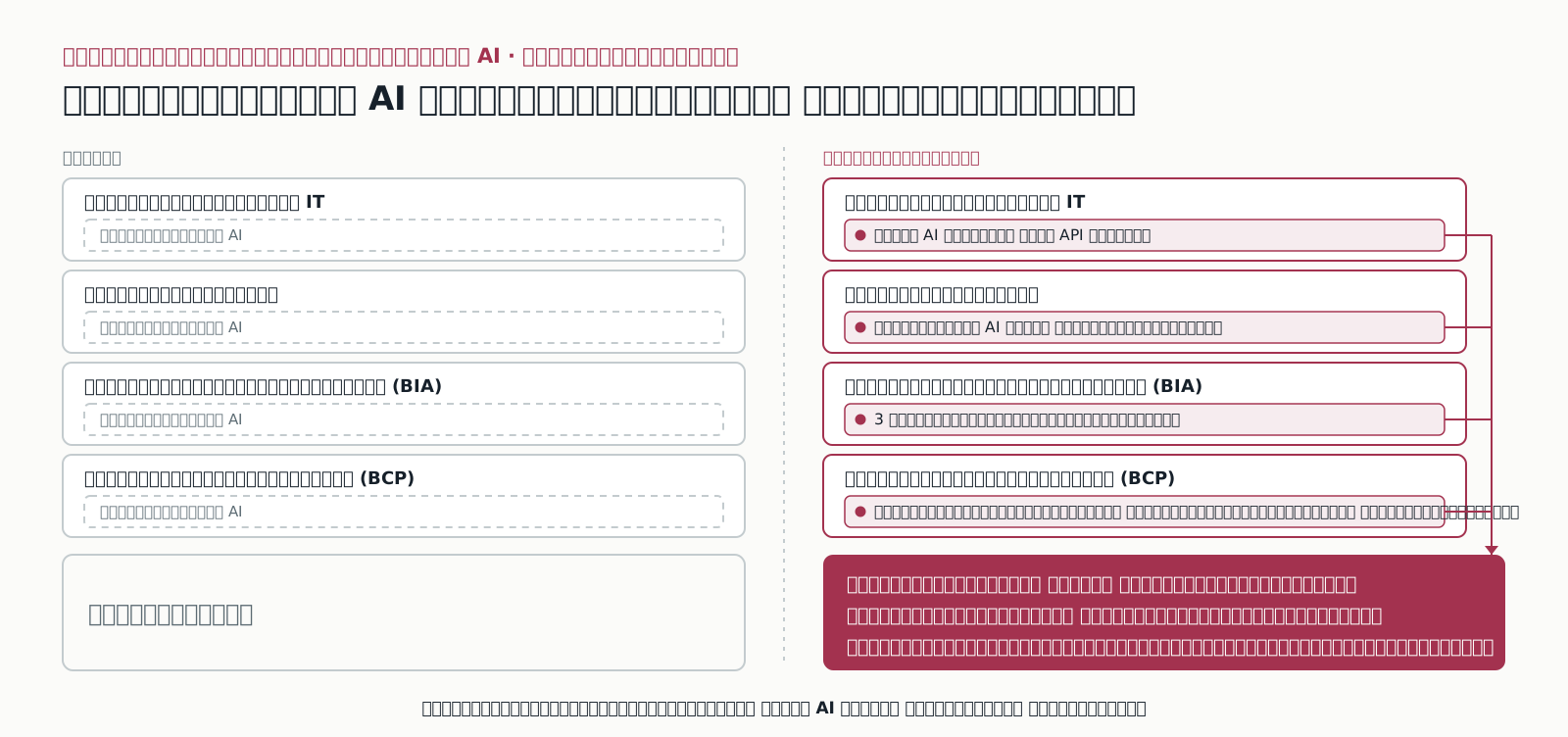
Before and after view of four records: the IT asset register, the third-party register, the business impact analysis and the business continuity plan. On the left, today, each record has an empty row marked no AI rows, and the answer box reads "We don't know." On the right, after the work, each record has one AI row: model, version, key and owner; provider, contract and exit option; three processes that depend on the provider; and an outage scenario with a reduced mode and who switches. Lines from the four rows lead to the answer: three processes stop, customer chat assistant, loan document reading and credit memo drafting, each with an owner and a reduced mode. ภาพเปรียบเทียบก่อนและหลังของเอกสารสี่รายการ ได้แก่ ทะเบียนทรัพย์สินด้าน IT ทะเบียนบุคคลภายนอก การวิเคราะห์ผลกระทบทางธุรกิจ และแผนความต่อเนื่องทางธุรกิจ ด้านซ้ายคือวันนี้ แต่ละรายการมีแถวว่างที่ระบุว่ายังไม่มีรายการ AI และกล่องคำตอบระบุว่ายังตอบไม่ได้ ด้านขวาคือหลังทำงานร่วมกัน แต่ละรายการมีแถว AI หนึ่งแถว ได้แก่ โมเดล เวอร์ชัน คีย์ และเจ้าของ ผู้ให้บริการ สัญญา และทางเลือกในการยกเลิก สามกระบวนการที่พึ่งพาผู้ให้บริการรายนี้ และสถานการณ์ขัดข้องพร้อมรูปแบบการดำเนินงานแบบจำกัดและผู้มีอำนาจสั่งสลับ เส้นจากทั้งสี่แถวนำไปสู่คำตอบว่า สามกระบวนการจะหยุด ได้แก่ ผู้ช่วยแชตสำหรับลูกค้า การอ่านเอกสารสินเชื่อ และการร่างบันทึกเสนอสินเชื่อ โดยแต่ละกระบวนการมีเจ้าของและรูปแบบการดำเนินงานแบบจำกัดรองรับ
The same four records, before and after. The answer only exists once the AI rows do.

Most organisations cannot answer either straight from their records. AI arrives through doors that registers do not watch: staff using public generative AI, AI features switched on inside software you already license, and AI keys and payments that nobody recorded. Until the registers, the BIA and the BCP show these dependencies, nobody can say which process stops when an AI provider fails or changes its model.

Every regulated organisation already keeps the records this work needs. Banks, state enterprises, government agencies and listed companies all run risk management, keep continuity plans, and answer to someone who checks them: a regulator, an oversight body or an audit committee. The PDPA applies to all of them. What is new is AI inside those records, not the records themselves. Thai banking shows how close the hooks already are: BOT's IT risk rules require a complete IT asset register and continuity for third-party services, and its AI guideline asks for AI risk to be identified and monitored. For financial supervision, Singapore's MAS shows where the rules are heading, with dates.

Who it is for

  • Sponsor: the CIO, CDO, CISO or DPO, who holds the budget and the systems.
  • At the readout: your CRO and chief audit executive, because the results land in their registers, BIA and BCP.
  • Sectors: banks and specialised financial institutions, regulated payment firms, listed companies and state enterprises that run AI in real processes.

What you receive

  • A heat map of your AI risk coverage. Each area is rated red, amber or green against the Thai rules that apply to you, and against a recognised international reference where Thai rules are silent. There is no overall score, because an average hides the red areas.
  • The basis for every rating. For each red or amber area: what we checked, what we found, and whether it rests on documents we saw or answers we were given. Your auditors can trace every rating.
  • Spot checks your own staff run. They cover public generative AI use, AI features in licensed software, and AI keys and payments outside any register. Results come back as counts by tool and department.
  • Outcomes in priority order, not a shopping list. Each outcome is tied to the gap it closes and written so any provider could deliver it. Where a gap needs deeper assessment first, we say so. "No further work needed" is a valid result.
  • A readout for your sponsor, with your CRO and chief audit executive invited.

What this covers, and what can follow

This engagement is the assessment. Building fixes and running them are separate choices. They are quoted only after you accept the assessment, and you can take the findings to anyone.

Assess: this engagement
Gap check, AI dependency discovery and inventory, materiality and continuity analysis.
Build: next step
A second provider or model behind one controlled exit, with a named person who switches. Reduced-service playbooks practised with staff. Agent guardrails. A data boundary for personal and confidential data. Delivered through AI Development.
Run: ongoing care
Monitoring of your AI dependencies, periodic re-inventory, and an annual tabletop exercise. Delivered through AI Analytics and AI Excellence.

How it runs

Five steps, two lanes: what we do and what your team does. Nothing leaves your premises until you approve the report.
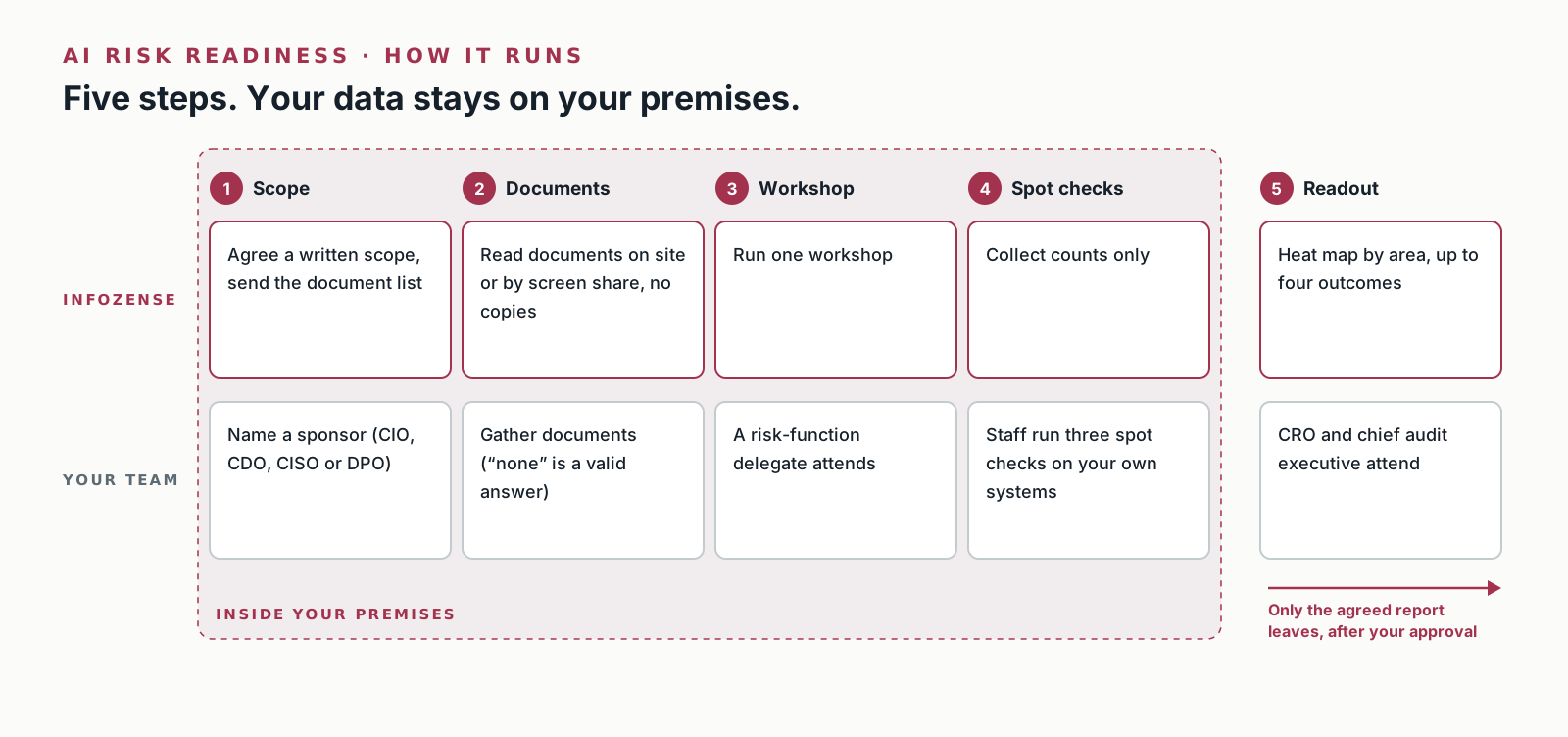
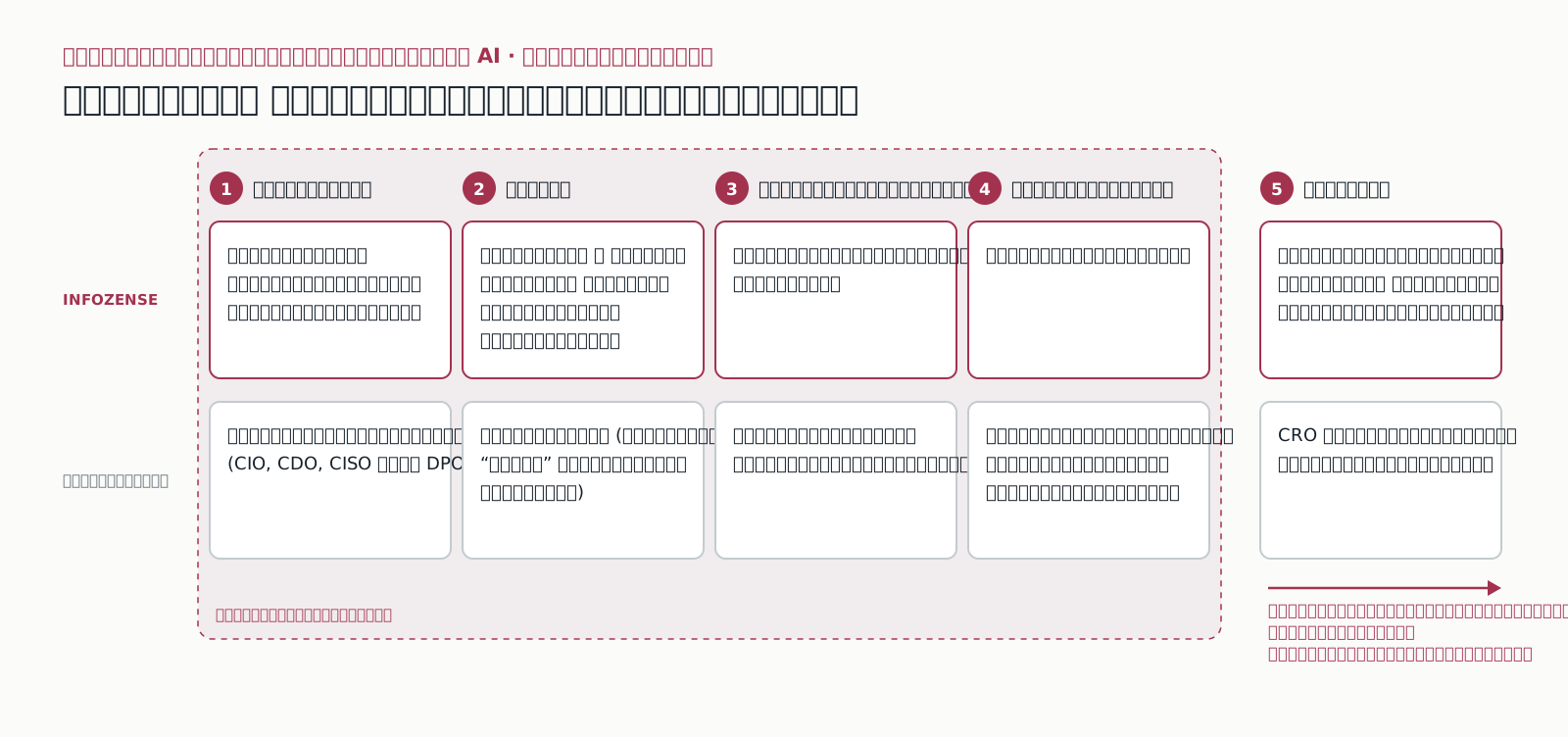
How the first engagement runs, in five steps and two lanes. INFOZENSE: agrees a written scope and sends the document list; reads documents on site or by screen share without copies; runs one workshop; collects counts only; delivers a heat map by area with up to four outcomes. Your team: names a sponsor, who is the CIO, CDO, CISO or DPO; gathers documents, where "none" is a valid answer; sends a risk-function delegate to the workshop; runs three spot checks on your own systems; and brings the CRO and chief audit executive to the readout. Steps one to four happen inside your premises. Only the agreed report leaves, after your approval. ขั้นตอนการทำงานครั้งแรก ห้าขั้นตอน สองฝั่ง ฝั่ง INFOZENSE ตกลงขอบเขตงานเป็นลายลักษณ์อักษรและส่งรายการเอกสาร อ่านเอกสาร ณ สถานที่ขององค์กรหรือผ่านการแชร์หน้าจอโดยไม่ทำสำเนา จัดประชุมเชิงปฏิบัติการหนึ่งครั้ง รับเฉพาะตัวเลขจำนวน และส่งมอบแผนภาพระดับความเสี่ยงแยกตามด้านพร้อมผลลัพธ์ที่ควรทำไม่เกินสี่ข้อ ฝั่งทีมขององค์กร ระบุผู้สนับสนุนโครงการซึ่งเป็น CIO, CDO, CISO หรือ DPO รวบรวมเอกสารโดยการตอบว่าไม่มีถือเป็นคำตอบที่ใช้ได้ ส่งผู้แทนจากหน่วยงานบริหารความเสี่ยงเข้าร่วมประชุม ให้บุคลากรตรวจสอบเฉพาะจุดสามรายการบนระบบขององค์กรเอง และเชิญ CRO กับหัวหน้าหน่วยงานตรวจสอบภายในเข้าร่วมการนำเสนอผล ขั้นตอนที่หนึ่งถึงสี่ดำเนินการภายในองค์กร มีเพียงรายงานที่ตกลงกันเท่านั้นที่ออกจากองค์กร และหลังจากองค์กรอนุมัติแล้ว
Five steps, two lanes. Everything up to the readout happens inside your premises.

In short, you provide: a named sponsor, a written scope, the documents on our list ("none" is a valid answer), a risk-function delegate for the workshop, staff to run the spot checks, and time for the readout.

Independence, stated plainly

How we keep the assessment clean

  • INFOZENSE resells and partners with several technology vendors. Every relationship is disclosed in writing in each proposal, and no assessment names any vendor or product.
  • The assessment names outcomes, never implementation services or products. "No further work needed" is a valid result.
  • Any implementation is quoted separately, and only after you accept the assessment. You can take the findings to anyone.
  • Anything we built or operate for you is inventoried but not judged by us. Your internal audit or a named third party reviews it.

Your data stays with you

The first check needs no access to your systems. We view documents on your premises or through your screen share, and we take no copies. In deeper discovery, every script runs inside your environment, under your accounts, and your CISO reviews it first. Only the agreed deliverables leave, after your approval.

Our consultants do the reading and the judgement. If AI helps them search a large document set, you decide which documents it may see and where it runs, and that choice is written into the engagement letter.

Consulting · AI · Excellence

Can Your Registers See the AI You Already Use?

Start with a gap check on evidence, scored by area, with outcomes you can take to anyone.

Book a Scoping Call →

contact@infozense.com  |  +66-82-242-4008  |  Bangkok, Thailand