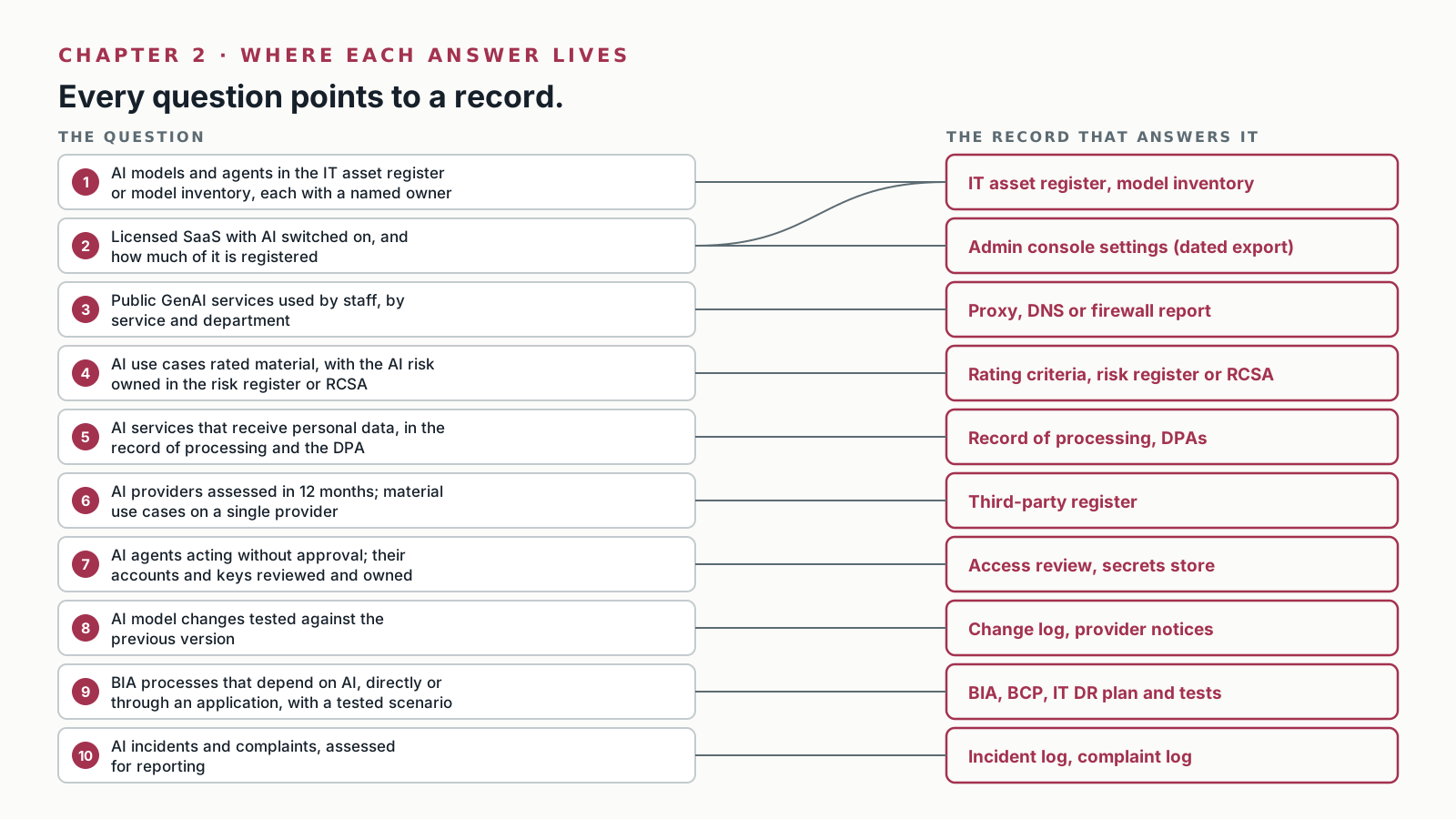
1. How many AI models and how many AI agents are in the IT asset register or the model inventory, and how many of each have a named owner?
Why it matters. Most regulated organisations must keep an IT asset register, and the AI they run is part of their IT. Read plainly, a model and an agent are IT assets; that is our reading, not a regulator’s statement. In practice the register often lists the application that uses AI, not the model or agent behind it, and banks may keep in-house models in a separate model inventory. If the count is zero, the register is likely incomplete, or it records AI only at the level of the application; ask which. Two separate counts matter because they fail differently: a model can be wrong, an agent can act. Owners matter because an unowned row has nobody to switch it off. The keys these services use are counted in question 7. Banking example: BOT’s IT risk notification makes the register binding and requires it to identify IT assets completely (attachment 2, clause 1).
Evidence that answers it. The register extract, and the model inventory where one exists, filtered to AI, with owner and last-updated date per row. Then sample two rows and trace each one to the running system.
2. How many of the software services we already license have AI features switched on, and how many of those features appear in the register?
Why it matters. This is the most common way AI arrives without a purchase order. A vendor adds an AI feature to the office suite, the CRM or the service desk. An administrator switches it on, and the organisation’s data starts reaching a model through a contract nobody re-read. A later chapter in this series covers this route, AI that arrives inside licensed software, in detail.
Evidence that answers it. For each licensed service, a dated export of the AI feature settings and AI add-on licences from its admin console, set against the register. The console shows the current state only, so the export date matters.
3. In the last three months, how many unapproved public generative AI services did staff use, counted by service and by department, and from which report?
Why it matters. An approved-tools list only works if someone checks it against use. Naming the report matters as much as the count. "We block it" is a claim. A block report is evidence.
Evidence that answers it. A web proxy, DNS, firewall or cloud access security report for known generative AI domains, counted by service and by department, not by named employee. Smaller organisations may not be able to split by department; say so rather than estimate.
4. How many AI use cases have been rated against our criticality or materiality criteria, how many came out material, and for how many of those does the risk register or risk and control self-assessment record the AI risk with a named risk owner?
Why it matters. Every regulated organisation has some way of deciding which systems and changes matter most: a criticality rating, a materiality rating, a list of critical services. Those ratings decide which controls, approvals and reports apply. In practice they are applied to systems, so an AI use case is usually rated through the application it runs on; a use case that sits in no rated system was never tested against any of them. The risk register or self-assessment is the second check. It is kept by process, not by use case, so the question is whether the process risk names the AI at all. If it does not, the AI risk sits outside the risk management the board relies on. Banking example: under clause 9 of BOT’s IT risk notification, each bank sets its own materiality criteria, approved by a committee the board delegates and reviewed every year. Those criteria decide whether a change needs advance notice to BOT (commercial banks, clause 10.1.1) or BOT’s permission (specialised financial institutions, clause 10.1.2).
Evidence that answers it. The approved rating criteria with their last review, the list of AI use cases with the rated system each runs on, and the risk register or self-assessment entries that name the AI, with owner and last review date.
5. How many AI services, approved or built into licensed software, receive personal data, and for how many does the record of processing name the service, and the data processing agreement state where the data is processed, how long it is kept, and whether the provider may use it to train its models?
Why it matters. For most risk committees, where personal data goes is the first question about AI, and the Personal Data Protection Act applies in every sector. An AI service that receives personal data but is missing from the record of processing is a gap the data protection officer will recognise at once. The record of processing usually names the software, not the AI feature inside it, and it does not hold contract terms: location, retention and training use sit in the data processing agreement or the contract, kept by legal or procurement. The training-use term matters because it decides whether the data stays inside the service the organisation bought. Banking example: BOT’s AI guideline expects access control, masking and similar safeguards for personal data used with AI (ส่วนที่ 2 (1.3)), and states that providers must comply with personal data protection law (Q&A 4).
Evidence that answers it. The record of processing filtered to AI services, and for each one the data processing agreement or contract clause that states the processing location, the retention period and the training-use term, with its date.