The tick grid dominates everything. Market makers can't compete on price — only on quantity.
Across SET common stocks — from 3-baht small caps to 143-baht large caps — the bid-ask spread reaches its minimum tick size for the vast majority of the session. The spread isn't tight because of competition. It's tight because it can't be anything else.
| Symbol | Avg Price (THB) | Tick (THB) | Median Spread (ticks) | % of Day at 1 Tick |
|---|---|---|---|---|
| DELTA | 143 | 0.50 | 1.00 | 97.9% |
| PTTEP | 123 | 0.50 | 1.00 | 98.6% |
| INTUCH | 95 | 0.25 | 1.00 | 96.7% |
| GULF | 57 | 0.25 | 1.00 | 98.1% |
| BCP | 28 | 0.25 | 1.00 | 98.7% |
| TRUE | 11 | 0.10 | 1.00 | 99.4% |
| EA | 4 | 0.02 | 1.00 | 98.7% |
| VGI | 3.55 | 0.02 | 1.00 | 97.5% |
"The tick grid holds the spread at its minimum. What looks like market-maker competition is actually a regulatory floor."
SET indexes tick size to price level. The grid has eight tiers. The tick-to-price ratio is not proportional — small changes near tier boundaries produce large jumps in relative trading cost.
| Price Range (THB) | Tick Size (THB) | Example Stock | 1-Tick in bps |
|---|---|---|---|
| < 2 | 0.01 | sub-baht names | 50 – 1000+ |
| 2 – 5 | 0.02 | VGI, EA | 40 – 100 |
| 5 – 10 | 0.05 | MEDEZE | 50 – 100 |
| 10 – 25 | 0.10 | TRUE, KCE | 40 – 100 |
| 25 – 100 | 0.25 | BCP, GULF, INTUCH | 25 – 100 |
| 100 – 200 | 0.50 | PTTEP, DELTA | 25 – 50 |
| 200 – 400 | 1.00 | — | 25 – 50 |
| ≥ 400 | 2.00 | SET50 heavy | ≤ 50 |
"A stock at 4.99 THB (1 tick = 40 bps) trades more cheaply than one at 5.01 THB (1 tick = 100 bps). A 0.4% price difference produces a 2.5× jump in relative spread cost. These tier-boundary effects are invisible in aggregate data."
When the spread can't narrow below 1 tick, market makers can't compete on price. They compete on the next dimension: quantity at the best bid and ask. This explains Chapter 3's finding from a different angle.
99.9% of Level 1 book updates are quantity adjustments at the same price. Only 0.19% involve actual price movement.
The tick grid locks the spread at its minimum. With price fixed at 1 tick, the only remaining variable is quantity — which is exactly what the book reflects.
Two observations. One market structure. Chapters 3 and 4 describe the same phenomenon — the tick grid's dominance — through the complementary lenses of order-book dynamics and spread measurement.
The pattern on SET — spreads pinned at 1 tick, quantity-driven competition, invisible adverse selection — is not a Thai peculiarity. It is the well-documented signature of a market where the tick floor is binding.
The tick size literature has documented for decades that a binding minimum tick forces market makers to compete on quantity rather than price (Harris 1991, 1994). When the spread cannot narrow further, liquidity providers can only distinguish themselves by how much size they post at the best bid and ask — which is exactly the pattern we see on SET.
Research on relative tick size (O'Hara, Saar & Zhong 2019; Yao & Ye 2018) shows that stocks with larger relative ticks experience more quote-size competition, less price competition, and compressed adverse-selection signals in standard spread models. Stepped tick grids — used by SET, Tokyo, and Hong Kong, and introduced across Europe via MiFID II — are known to create tier-boundary discontinuities, where small price changes produce step-function jumps in relative spread cost (Ahn, Cai, Chan & Hamao 2007).
The US experience provides a natural contrast. When NYSE and NASDAQ moved from $0.125 ticks to $0.01 in 2001 — decimalization — spreads narrowed, displayed depth fell, and traditional market makers were replaced by thin-margin electronic liquidity providers (Bessembinder 2003; Chakravarty, Panchapagesan & Wood 2005). The SEC Tick Size Pilot (2016–2018) ran the experiment in reverse, increasing tick size on 1,200 small-cap stocks, and found the same relationship: larger ticks attract more displayed depth but shift trading toward dark venues.
"The implication for SET is clear. The market structure we observe — spreads pinned at 1 tick, quantity-driven competition, invisible adverse selection — is the well-documented signature of a binding tick floor."
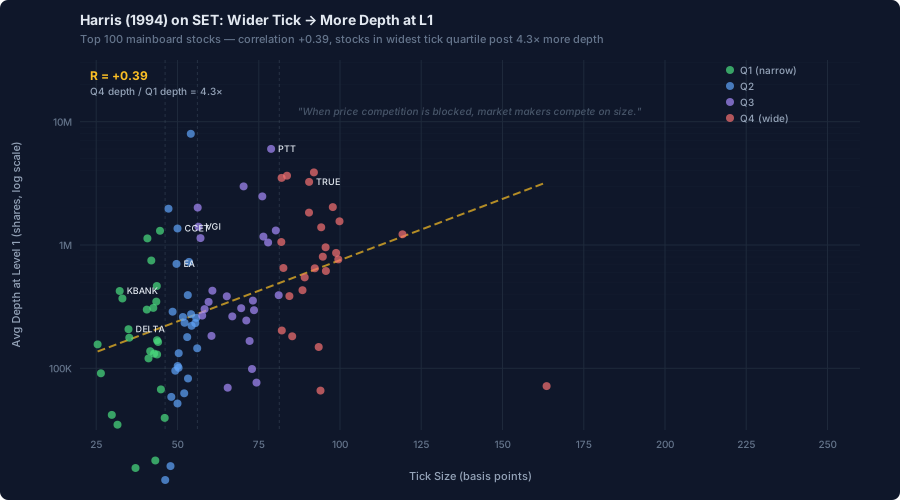
Harris (1994) predicted that a binding tick floor pushes market makers into quantity competition. We tested this directly on SET using the top 100 mainboard stocks, grouped by relative tick size.
The relationship between tick width and displayed depth is not an all-or-nothing finding at the extremes. Each quartile of tick width produces more depth than the one below it.
Harris (1994) confirmed on SET. Quartile averages: Q1 284K → Q2 637K → Q3 949K → Q4 1,228K shares. R = +0.39.
| Tick Quartile | Avg Tick (bps) | Avg L1 Depth (shares) | Vs. Previous Quartile |
|---|---|---|---|
| Q1 (narrowest) | 39 | 284,000 | — |
| Q2 | 51 | 637,000 | 2.2× |
| Q3 | 68 | 949,000 | 1.5× |
| Q4 (widest) | 95 | 1,228,000 | 1.3× |
Every step up in tick width produces a step up in depth. The end-to-end ratio (Q4 vs Q1) is 4.3×, but what matters more is the consistency: the pattern is monotonic across all four buckets, not driven by outliers in one group.
This is what Harris (1994) predicted. When the spread cannot narrow, market makers compensate with quantity — and the wider the spread floor, the more quantity they are willing to post. The correlation (R = +0.39) is moderate because many stock-specific factors contribute to depth, but the quartile ladder is unambiguous.
Tick-grid dominance changes how you should think about measurement, research, and execution on SET.
Standard spread-decomposition models assume continuous spreads. Stepped tick grids break that assumption — tick-aware models (Harris 1991, 1994; Holden 2009) are the right tool for markets like SET. For microstructure research on SET, event-study windows around earnings announcements — where spreads temporarily widen beyond 1 tick — offer a natural view into informed trading that the tick floor otherwise masks.
The US decimalization literature showed that removing a binding tick floor immediately tightens spreads and reveals informed-trading signals that were previously masked. Stepped tick grids — used by SET, Tokyo, Hong Kong, and European markets under MiFID II — are known to create tier-boundary effects where stocks just above a boundary trade worse than those just below. Published microstructure research on SET is limited; the patterns we observe invite further study, particularly tick-size-aware decomposition models.
Your transaction cost on SET is mostly determined by the tick size at your stock's price — not by bid-ask dynamics. The highest-priced large caps (DELTA, PTTEP, INTUCH) sit at 25-40 bps round-trip. Mid-priced stocks land at 40-100 bps. Stocks just above a tick-tier boundary (5.01, 25.01, 100.01 THB) can cost more to trade than cheaper stocks just below. Understanding the tick grid — not reading spread models — is where execution cost control starts.
We attempted the Fong-Holden-Trzcinka (2017) low-frequency estimator, which uses daily return volatility and the proportion of zero-return days to infer transaction cost when the observable spread is at the tick floor. For most stocks, 22 trading days was insufficient to produce a reliable estimate. Reported here for transparency.
| Symbol | Avg Price (THB) | 1-Tick (bps) | p_zero | FHT Est (bps) | Note |
|---|---|---|---|---|---|
| DELTA | 143 | 35 | 9.5% | 67 | estimate produced |
| PTTEP | 124 | 40 | 0% | — | insufficient data |
| INTUCH | 98 | 25 | 9.5% | 31 | near tick |
| GULF | 59 | 43 | 4.8% | 19 | near tick |
| CPALL | 56 | 45 | 9.5% | 49 | near tick |
| BCP | 34 | 73 | 14.3% | 72 | matches tick |
| PTT | 31 | 80 | 42.9% | 153 | elevated (volatile days) |
| TOP | 26 | 95 | 19.0% | 131 | elevated |
| HANA | 24 | 42 | 9.5% | 55 | near tick |
| KCE | 23 | 44 | 9.5% | 59 | near tick |
| PTTGC | 23 | 44 | 0% | — | insufficient data |
| TRUE | 12 | 86 | 9.5% | 54 | below tick |
| MEDEZE | 9 | 53 | 9.5% | 112 | elevated |
| HMPRO | 9 | 55 | 9.5% | 63 | near tick |
| CCET | 9 | 56 | 4.8% | 41 | below tick |
| BTS | 6 | 84 | 0% | — | insufficient data |
| VGI | 3.3 | 61 | 0% | — | insufficient data |
| EA | 3.3 | 61 | 0% | — | insufficient data |
| IVF | 1.6 | 63 | 0% | — | insufficient data |
| SCM | 0.7 | 152 | 0% | — | insufficient data |
13 of 20 stocks produced an FHT estimate; 7 collapsed to zero for lack of zero-return days in the 22-day window. A 1-year sample would allow a fuller test.
Harris, L. (1991). Stock price clustering and discreteness. Review of Financial Studies, 4(3), 389–415.
Harris, L. (1994). Minimum price variations, discrete bid-ask spreads, and quotation sizes. Review of Financial Studies, 7(1), 149–178.
Angel, J. (1997). Tick size, share prices, and stock splits. Journal of Finance, 52(2), 655–681.
Bessembinder, H. (2003). Trade execution costs and market quality after decimalization. Journal of Financial and Quantitative Analysis, 38(4), 747–777.
Chakravarty, S., Panchapagesan, V., & Wood, R. (2005). Did decimalization hurt institutional investors? Journal of Financial Markets, 8(4), 400–420.
Ahn, H.-J., Cai, J., Chan, K., & Hamao, Y. (2007). Tick size change and liquidity provision on the Tokyo Stock Exchange. Journal of Japanese and International Economies, 21(2), 173–194.
Yao, C., & Ye, M. (2018). Why trading speed matters: A tale of queue rationing under price controls. Review of Financial Studies, 31(6), 2157–2183.
O'Hara, M., Saar, G., & Zhong, Z. (2019). Relative tick size and the trading environment. Review of Asset Pricing Studies, 9(1), 47–90.
SEC (2018). Report on the Tick Size Pilot Program.
Data: one month of SET ITCH tick data from 2025, covering 22 trading days across ~1,900 mainboard common stocks. Tick size rules reflect SET's published schedule. Patterns described here may evolve as market structure changes; findings should be treated as a snapshot, not a permanent property of the market.
This study uses licensed market data obtained through commercial agreement. Infozense is not affiliated with the Stock Exchange of Thailand. No market data is distributed through this website. This content is for educational and analytical purposes only and does not constitute investment advice.