Four dimensions of liquidity: width, depth, immediacy, resiliency.
Liquidity has four axes. Each can be measured independently from tick data, and each tells a different story about market quality.
"Liquidity is not a single number. It is a multi-dimensional concept. A market can be wide but deep, or narrow but shallow. Each combination produces different risks for different traders."
The order book is constantly being revised. Three out of every four messages change an existing order rather than creating or removing one. This is the heartbeat of immediacy.
The dominance of Change messages tells us that most market-making activity consists of price and quantity adjustments — not fresh order submission. Algorithmic market makers continuously revise their quotes to track fair value, creating the illusion of a static book that is in fact rebuilt thousands of times per second.
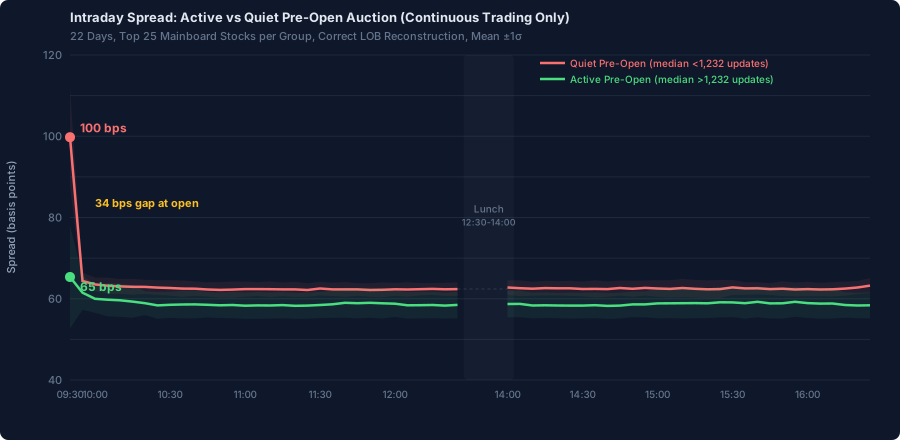
Spread measured as relative spread in basis points — normalized by midpoint price so stocks at different price levels are comparable. Stocks with active pre-open auctions open 34 bps tighter. By 10:15, the gap narrows. During continuous trading, spreads are remarkably stable at ±3 bps.
Relative Spread (bps) = 10,000 × (Ask − Bid) / Midpoint
Stocks with active pre-open auctions enter continuous trading with 34 basis points tighter spreads. The auction establishes price discovery before 10:00, reducing opening uncertainty. By 10:15, both groups settle into steady state (~59-62 bps). A ~4 bps gap persists throughout the day — quietly auctioned stocks remain slightly wider.
The best bid (Level 1) carries 8.3 million observations — far more than any other level. By Level 5, depth has dropped by roughly half. By Level 10, it is a fraction of the top.
This steep decay is consistent with the observation that most liquidity is concentrated near the best price. Institutional traders who need to execute large blocks must sweep through multiple levels, paying an increasing premium at each step — the cost of depth depletion.
Resiliency is how quickly the book recovers after being hit. We measure it by decomposing all Level 1 updates: how often does the price improve (tighten the spread) vs worsen (widen it)?
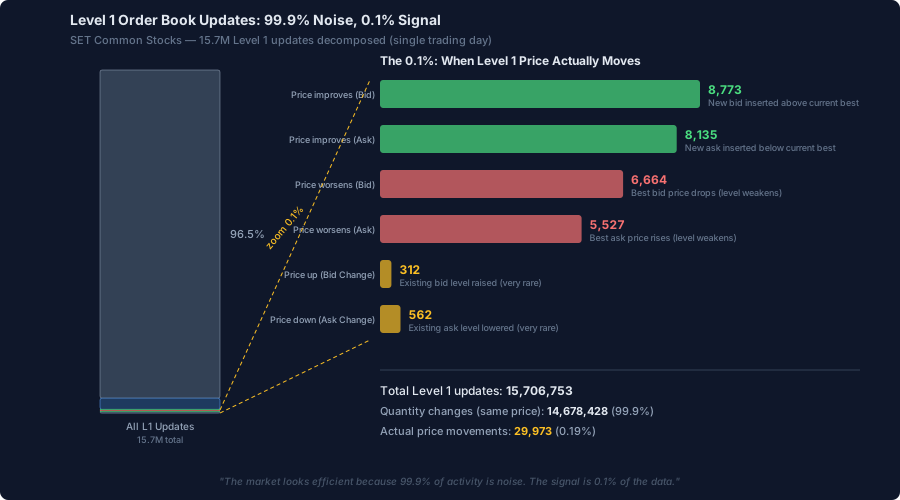
Out of 15.7 million Level 1 updates in a single trading day, 99.9% are quantity changes at the same price — the market constantly adjusting size without moving the price. Only ~30,000 updates involve an actual price movement.
Among those 30,000 price-moving updates, improvements consistently outnumber worsenings by a ratio of ~1.08 — for every 100 times someone widens the spread, 108 times someone tightens it. This ratio holds across all 22 trading days, with weak correlation to market direction (R=0.30).
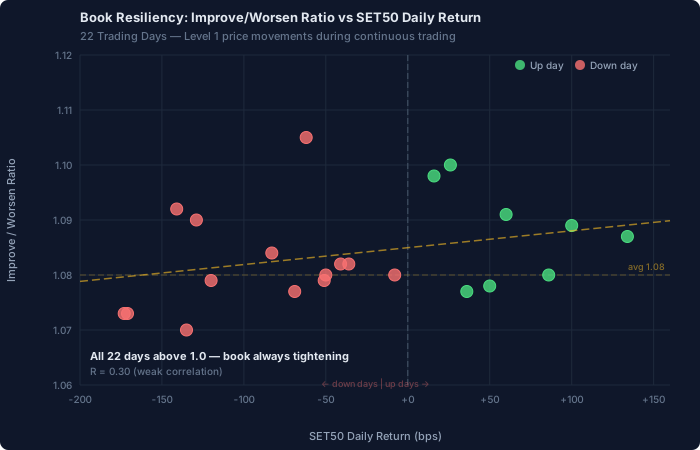
During the study period, the order book showed a consistent improvement bias even on down days — suggesting participants expected better prices ahead, or were competing for order flow. This ratio is a measure of book-level sentiment — distinct from price returns. Whether it persists, or flips below 1.0 during stressed conditions, requires further study.
Not all instruments are equally immediate. The most active names generate over a million order book events per session, while the median instrument updates fewer than a thousand times. This concentration defines who gets fast execution and who does not.
The gap between the most active and least active instruments spans three orders of magnitude. For DELTA, the book is refreshed every millisecond. For a small-cap, it may sit unchanged for minutes. Both are "liquid" by different definitions — the immediacy dimension captures this distinction precisely.
The same liquidity data serves engineering, research, and business objectives in different ways.
Processing 7,414 events/second requires architectures that handle bursty workloads. The 72.5% Change ratio means your update pipeline dominates insert/delete — optimize for in-place modifications, not append-only logs. Column stores with delta encoding compress Change-heavy streams 10x better than row stores.
The intraday spread pattern shows a clear opening spike that settles within 15 minutes — stocks with active pre-open auctions enter trading 34 bps tighter. Order book depth drops steeply beyond Level 1, with the best price holding the majority of available quantity. Separately, 99.9% of top-of-book updates are quantity adjustments at the same price — only 0.19% involve actual price movement. Among those, improvements outnumber worsenings 1.08:1 across all trading days — a measure of book-level sentiment rather than structural mechanics.
Spread width directly translates to transaction cost. Depth determines how large an order can be before moving the market. The data shows spreads settle within 15 minutes of the open, with a 34 bps difference between actively and quietly auctioned stocks at market open. After 10:15, spreads are stable at ~58-62 bps with ±3 bps daily variation — consistent across both sessions. Understanding these patterns helps quantify execution cost at different times of day.
This study uses licensed market data obtained through commercial agreement. Infozense is not affiliated with the Stock Exchange of Thailand. No market data is distributed through this website. This content is for educational and analytical purposes only and does not constitute investment advice.