If you own reimbursement at a Thai hospital, each of these lands on your desk as its own crisis, with its own tool and its own spreadsheet:
Under-coding, denials, audit exposure, rejected drug claims, code lookup, thin documentation. These six problems make a Thai hospital's reimbursement team fight six battles with six tools — when they're really one. One governed knowledge base wins all six: pre-bill, cited, checkable in baht by hand.
If you own reimbursement at a Thai hospital, each of these lands on your desk as its own crisis, with its own tool and its own spreadsheet:
A comorbidity the chart clearly documents never made it into the record. The DRG dropped a severity tier and the hospital quietly under-billed — and nothing flagged it.
An auditor is questioning a claim billed to a severity the chart doesn't support. That's a clawback and a penalty waiting to happen.
A claim came back rejected, and someone has to dig out the chart and the rule and write the appeal by hand.
A vancomycin charge is sitting exposed because the resistant-organism diagnosis that justifies it was never coded.
A coder isn't sure which code is right, and the codebook is a 1,000-page PDF.
The documentation was thin to begin with, so the right codes were never supportable at all.
Six fires. Six tools, six spreadsheets, six manual slogs. Here's what almost nobody says out loud: they are the same fire.
Every one of those is the same underlying check, asked from a different chair:
Does this coded claim agree with the codebooks, the fee schedule, and what the chart actually documents? Ask it six ways and you get your six 'tools' back.
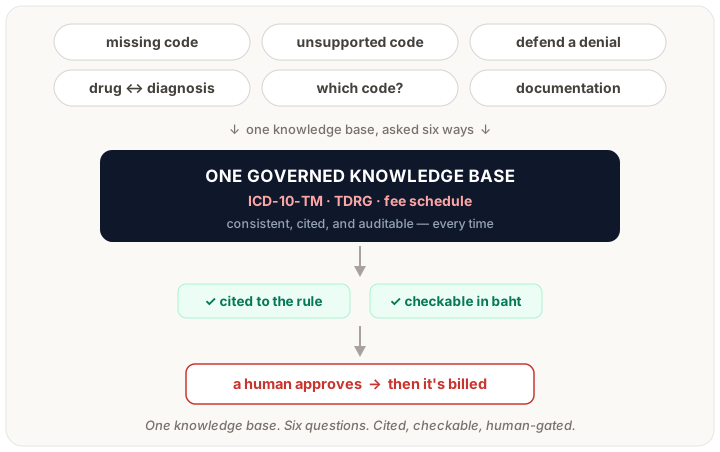
(revenue) Which documented, severity-promoting diagnoses were never coded?
(compliance) Which coded diagnoses does the chart not justify?
(appeals) What's the governing rule and the chart evidence, drafted into an appeal?
(pharmacy) Does each high-cost drug have the diagnosis that authorizes it?
(lookup) Which ICD-10-TM / TDRG codes does this chart actually support?
(upstream) What's missing for the codes to hold?
Same codebooks. Same fee schedule. Same charts. Different question — one knowledge base. This is Infozense's platform for knowledge management in your organization: one governed base, asked many ways.
Most AI systems will quote you a recovery number before they've even seen your data. We won't. The honest figure depends on your case mix and your payer's rates, and a number made up without your data is the first thing a finance team should question.
Here's where it helps: the system looks for the leak that hides in plain sight — a claim marked 'paid' that paid less than the chart supported, because a code that would have raised the case was missing. Nothing was rejected, so nothing flagged it, and the revenue quietly disappears. It surfaces gaps like these according to the knowledge it's been given.
Any baht figure traces to rules you already use — the published TDRG weights and your payer's rates (CSMBS, UCS, SSS) — so your finance team verifies every line itself. How much is actually slipping through your claims is measured on real data during the pilot.
It would be easy to build a tool that only hunts for codes that raise the bill — an upcoding bot, exactly what regulators police. This is the opposite. Three things make it hold up to an auditor:
It flags what you under-coded (revenue you earned) and what you over-coded (risk you should drop). That's coding integrity, not revenue maximization — and integrity is what survives a review.
The rule comes back with its source — the TDRG manual, the ICD-10-TM chapter — not a model's opinion. A coder can open the page and check.
The system recommends; your coder approves. Nothing auto-submits. Accountability stays with a named person, where a regulator expects it.
A pilot doesn't ask your hospital to buy a GPU or stand up new infrastructure. We stay flexible on how and where it runs, and we work within your PDPA and data-governance rules — so trying it is light, and the data handling fits your setup, not the other way around.
You don't have six coding problems. You have one — claims that don't yet agree with the chart — and you've been fighting it with six tools and a lot of overtime. One governed knowledge base catches all six: pre-bill, cited, calculator-checkable.
Revenue integrity is the first thing we point the system at, because it pays for itself quickly. But the engine isn't built for coding alone. Supplied with a different body of rules, it checks the same way in other areas — compliance and audit readiness, clinical-documentation review, drug-and-formulary alignment, and regulatory reporting. The knowledge base changes; the method, the citations, and the human sign-off stay the same. Reimbursement is where we start, not where it ends.
Read on: Six Leaks, Part Two: When Does Fixing the Leak Pay for Itself? →