
Knowledge Engineering · Data Rights

You Deleted the Record. Your AI Didn't.

Someone asks you to delete their data. You delete the record. But months ago you fed that record to your AI, and it can still pull the person's data into an answer from a source that officially no longer exists. Under today's privacy laws, a deleted row is not the same as a forgotten person. A governed data layer makes the deletion reach the AI, and proves it did.

Infozense Knowledge Engineering · CIO · DPO · Legal · Head of Data · ~4 minutes

This is the Data Rights piece of the Infozense Knowledge Engineering library. The data layer beneath your agent has five gates: Input (who may ask) · Egress (what may leave) · Output (safe and true) · Action (who approves) · Operational (prove it later). This piece is about the two that govern a “forget me” request: Action approves the deletion, Operational proves it happened.

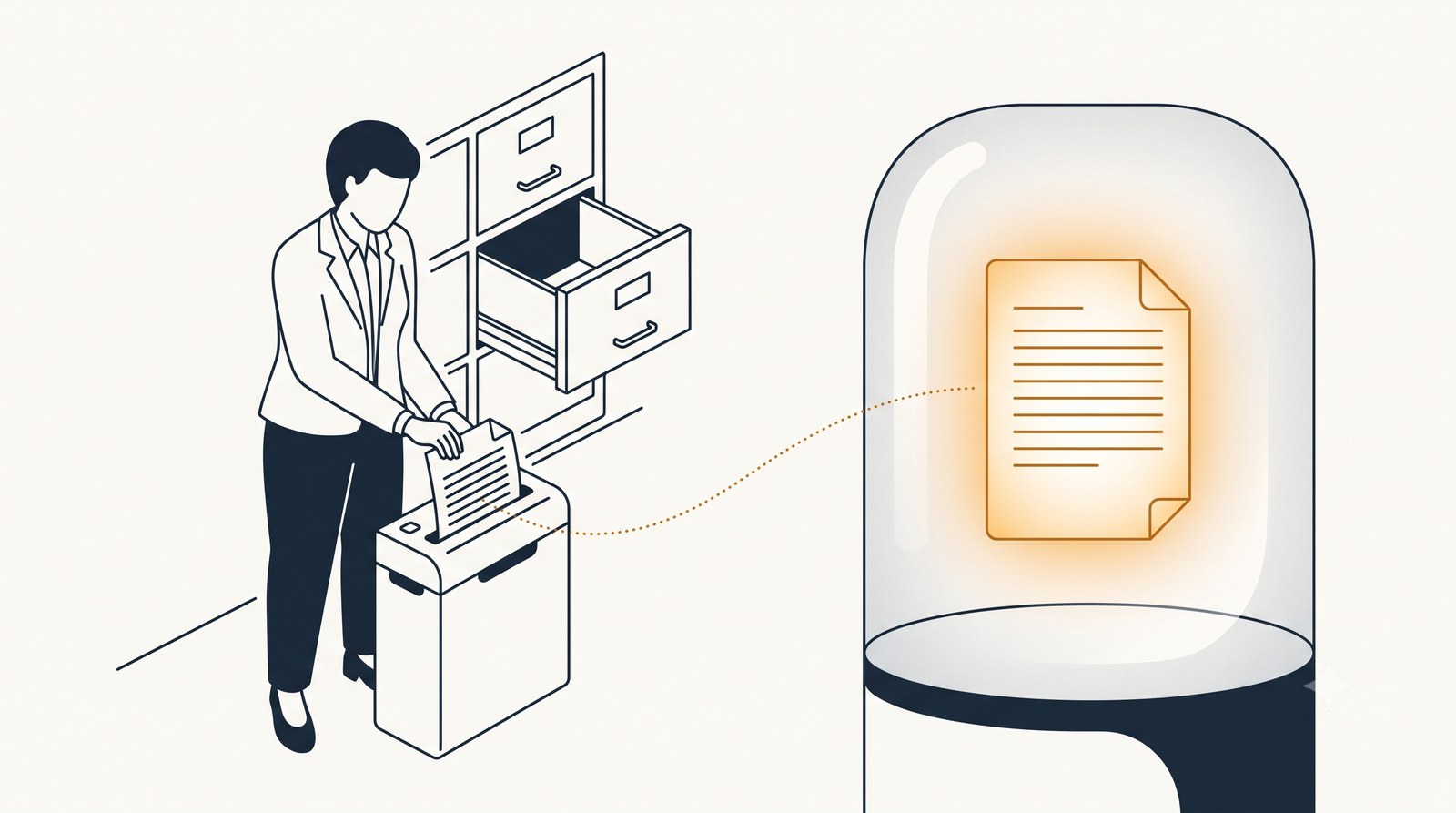
A person shreds a paper record beside an empty filing drawer, while an amber thread carries a copy of it across to a document still glowing inside a sealed dome, the copy the AI kept after the original was deleted.
The row is deleted. The AI's copy is not.

Someone exercises their right to be forgotten. Your team does the obvious thing. They delete the person's record from the systems built to hold it: the application, the database, the data warehouse. The row is gone, the ticket is closed, everyone moves on.

But feeding data to an AI is a separate pathway, and your deletion process was never built for it. To make the AI useful on your own data, you fed that data into it, broken into pieces and stored so the model could search and answer. That copy is a third place the person's data now lives, alongside the application and the warehouse, and it is the one nobody thinks to check. Deleting the record from the warehouse does nothing to it. Ask the AI the right question, and the person's data comes back in the answer, from a source that officially no longer exists.

That is the gap the law cares about. A privacy law is not satisfied by a deleted row. It is satisfied when the person's data stops appearing, everywhere it can appear, and when you can prove it stopped.

Who this is for

Most organizations do not have this problem, because they are not running AI on personal data. If your AI only answers from public information, you can stop here.

You have this problem when three things are true at once. You hold personal data: patients, customers, employees. You have fed some of it to an AI so it can answer questions about your own records. And you are under a privacy law that lets a person demand you erase their data and prove that you did. Different places call it the right to erasure or the right to be forgotten; the obligation is the same.

When those three are true, a deleted row is not enough, and a folder of deletion tickets is not proof.

What a real erasure has to do

An erasure that satisfies the law has to do two things. Most systems do neither.

First, it has to reach the AI. Removing the original record is not enough, because the AI answers from its own copy, not from the original. Unless that copy stops coming back too, the person's data is still one question away.

Second, it has to be provable. When a regulator asks, months later, whether you honored the request, “we are fairly sure we did” is not an answer. You need a record of exactly what was erased, who approved it, and when, and that record has to be one no one can quietly rewrite afterward.

How the governed layer does it

The reason this is fixable comes down to one fact: the copy the AI answers from is not scattered across your systems. It lives in one place, the layer that put it there. Knowledge engineering is the layer that ingested your document, broke it into pieces, and stored them so the AI could retrieve them. That pattern has a name, retrieval-augmented generation, or RAG, and most of it ships with no governance at all.

Knowledge engineering is more than RAG. It brings your knowledge together in many forms and from many sources, decides who may reach it, sorts it by sensitivity, and governs all of it, RAG included.

Because it is the layer that made the copy, it is the layer that can find and erase it. Erasure is not a separate tool you bolt onto your AI. It belongs to the same layer that already holds your knowledge.

In a governed data layer, a “forget me” request is not a ticket someone works through by hand. It is a governed action that moves through the layer the same way every time.

The request is written into a permanent ledger the moment it arrives, as a single record no one can change. From that point on, the layer keeps the person's data from surfacing: when the AI reaches for something to answer with, the erased data is filtered out, so it never reaches the answer. Because an erasure is permanent and cannot be undone, you can require that a named person approve it before it takes effect. And every step, the request, the approval, the erasure itself, stays in a record you can hand an auditor.

Two of the five gates do this work. The Action gate lets you require that a person approve the deletion, so nothing irreversible has to happen on its own. The Operational gate keeps the proof, in a log that no one, not even you, can change after the fact.

The bottom line

Without a governed layer, “we deleted it” is a hope. The row is gone, but you cannot swear the person's data will never surface again, and you cannot prove to a regulator that it will not. With one, the erasure reaches the AI, the person's data stops coming back, and the proof is already written down. The right to be forgotten does not stop at your AI's door.

You don't build this. You configure it.

Honoring erasure across an AI system sounds like a project. It is not, because you do not build the machinery. Infozense Knowledge Engineering ships the governed layer with the subject-rights ledger, the approval step, and the retrieval filtering already in place. You connect your data and set who is allowed to approve an erasure. The first “forget me” request is honored, and proven, from day one.

That is the difference between a policy that promises erasure and a layer that performs it.

Infozense Knowledge Engineering

Facing a “forget me” request and not sure your AI can honor it?

That's the conversation we have best. Bring one real case, and we'll walk it through the layer, from request to proof.

Let's talk →

contact@infozense.com  |  +66-82-242-4008  |  Bangkok, Thailand