Knowledge Engineering — Library Pillar

The Missing Piece Between Your Data and Your AI

Everyone is building AI agents. Almost no one is building the layer beneath them. So each agent connects straight to the data, one at a time — and the governance, the consistency, and the cost break apart across every connection. The missing piece isn't a smarter agent. It's the governed layer they should all share.

Infozense Knowledge Engineering · July 2026 · ~6 minutes · For CIO / CTO / Head of Data / Enterprise Architect
The Setup

You Solved This Problem Once Already

Years ago, every application connected directly to every system. Each new connection had its own setup, its own passwords, its own hidden assumptions — and together they became a tangle no one could trace or secure. So you stopped. You put one system in the middle: a gateway that everything connected through, one governed place for every request to pass. It was one of the best decisions your team ever made.

Now you're building AI — agents, copilots, assistants — and you're doing the exact thing you stopped doing before.

Your AI is only as good as the layer between it and your data. Most teams skip it — they wire each agent straight to the source, so every agent finds, structures, and governs that data on its own. Knowledge engineering builds that layer instead: one shared place that turns your data into knowledge every agent can use, and governs how they reach it.

The Problem

The Tangle Is Back — and This Time It's Your Data

Look at how each of these actually reaches your data — because your data doesn't move on its own. It stays where it lives, waiting, until an agent reaches in and pulls it. One agent connects straight to the warehouse. A copilot has its own connection to the document store. The next one reaches into a database directly. Each was built on its own, by whoever made it, one at a time. The same tangle as before. Only now what's being pulled through these connections isn't harmless system data. It's your customer records, your contracts, your patients.

And every one of those connections quietly answers the same four questions on its own:

Question 1

Who's allowed to see this?

Question 2

What's allowed to leave your organization?

Question 3

What has to be hidden before it's shown?

Question 4

What gets written down?

Answered once per agent — which means answered differently by each agent, or not at all. Connect ten agents and you've built the same connection ten times: ten copies of the access decision, ten logs that don't match, ten places where a rule gets forgotten. Every new agent starts from zero. That doesn't scale, and it won't survive an audit.

The Fix

The Missing Piece Is a Layer, Not a Better Agent

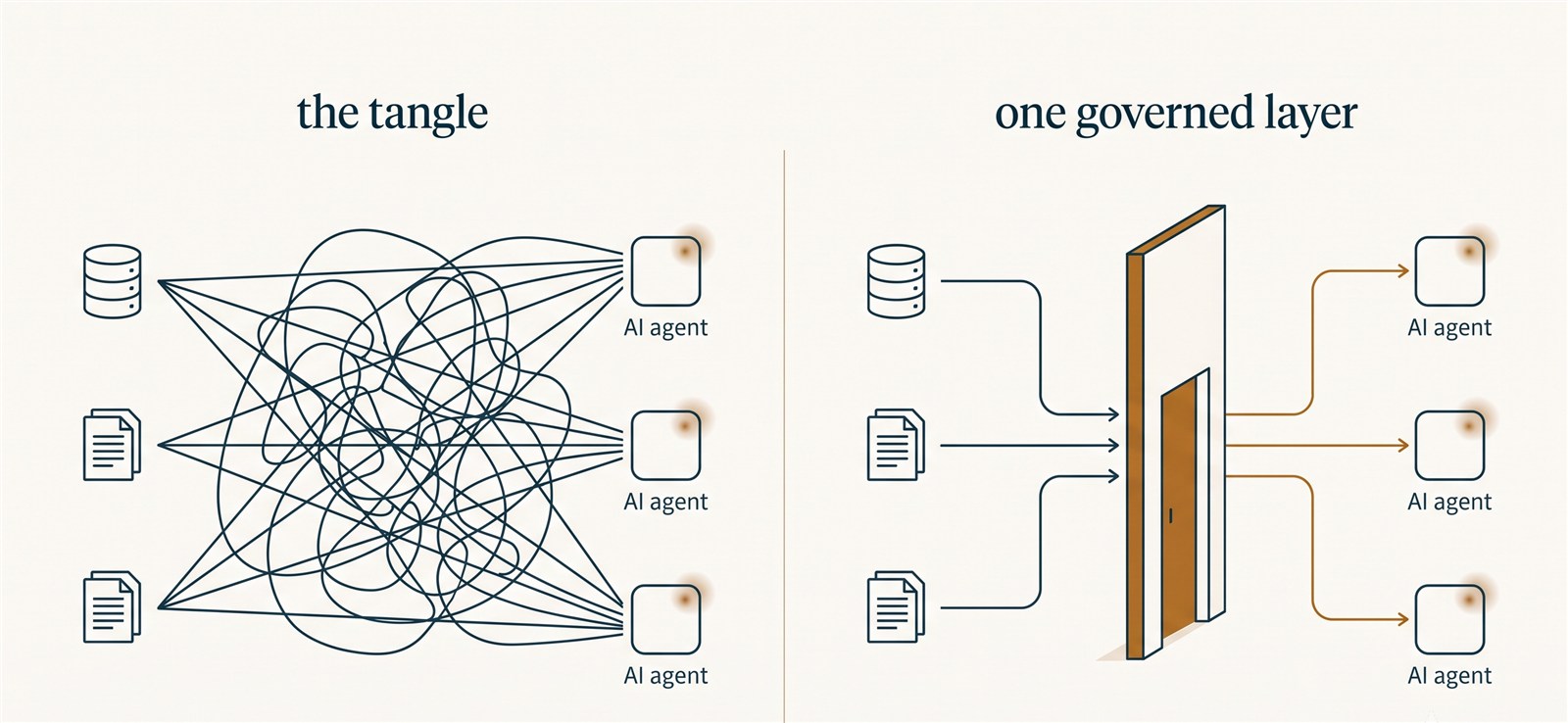
You don't fix this with a smarter agent. You fix it with the layer you skipped: one governed layer that sits between all your data and all your AI. Every agent asks the layer. No agent reaches the raw data on its own.

Two diagrams side by side. Left, labeled 'the tangle': data sources connected to AI agents by a dense tangle of crossing lines. Right, labeled 'one governed layer': the same sources and agents connected through a single door in a wall, with orderly lines in and out.
The tangle vs. one governed layer: every agent asks the layer — no agent reaches the raw data on its own.

Now those four questions get answered in one place, for every agent — who may ask, what may leave, what must be hidden, what must be logged. Answered once, so every agent gets the same answer.

But governing access is only part of what the layer does. It also turns your scattered data — databases, documents, systems — into knowledge an agent can actually find and use: bringing it together, structuring it, connecting it, keeping it current. That work belongs in the layer too. Governance is one job of many.

Building that layer is what knowledge engineering does — and it's much more than governance. You've done a version of this before: when you built an integration layer, you put one system in the middle, and every application connected through it instead of straight to each other. It's the same idea, now applied to the one flow you haven't centralized yet: the knowledge your AI uses.

The Payoff

Why the Layer Changes Everything

Once the layer is in place, four hard problems solve at once:

Add a new agent, and it follows every rule from its first day.

You don't set up the controls again.

Change a rule once, and every agent follows it right away.

You don't update each agent by hand.

One record of everything.

When a regulator asks what happened, you have one clear answer, not ten different ones.

Your data stays in one place.

It no longer spreads into many separate agents that you can't track.

This is the difference between running many small AI experiments and having one real AI capability. Separate experiments each carry their own connection and their own risk. A real capability stands on a shared layer.

Everything else builds on this layer. It controls what data may leave your organization. It answers a question from your data without the data leaving. It turns a thousand-page rulebook into an audit that shows its sources. Each of these is a job the layer does, and each one works only because the layer exists. We'll cover them one by one.

Closing

The Bottom Line

You don't need more agents. You need the layer they all stand on. Build your AI on a governed knowledge layer, and every new agent is safer, cheaper, and easy to prove — from the start. Skip the layer, and you go back to the same tangle — one ungoverned connection at a time — until the day someone asks you to prove where your data went.

Infozense Knowledge Engineering

Adding your third, fifth, or tenth AI agent — and the connections keep multiplying?

That's the conversation we have best. Bring your current setup and we'll show you where the layer goes.

Let's talk →

contact@infozense.com  |  +66-82-242-4008  |  Bangkok, Thailand